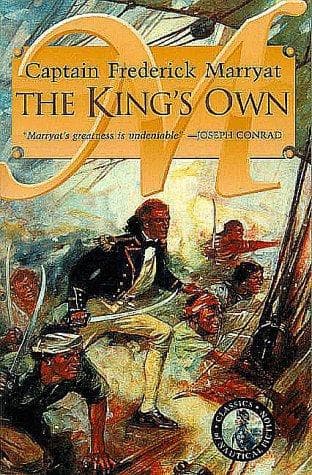
Great Britain -- History, Naval -- 18th century -- Fiction; Nore Mutiny, 1797 -- Fiction
In the foremost part of the main-deck of a line-of-battle ship, in a
square room, strongly bulk-headed, and receiving light from one of the
ports, as firmly secured with an iron grating--with no other furniture
than a long wooden form--his legs in shackles, that ran upon a heavy
iron bar lying on the deck--sat the unfortunate prisoner, in company
with three other individuals--his wife, his child, and old Adams, the
quartermaster. Peters was seated on the deck, supporting himself by
leaning against the bulkhead. His wife was lying beside him, with her
face hidden in his lap. Adams occupied the form, and the child stood
between his knees. All were silent, and the eyes of the three were
directed towards one of the sad company, who appeared more wretched and
disconsolate than the rest.
"My dear, dear Ellen!" said Peters, mournfully, as a fresh burst of
grief convulsed her attenuated frame.
"Why, then, refuse my solicitations, Edward? If not for yourself,
listen to me for the sake of your wife and child. Irritated as your
father still may be, his dormant affection will be awakened, when he is
acquainted with the dreadful situation of his only son; nay, his family
pride will never permit that you should perish by so ignominious a
death; and your assumed name will enable him, without blushing, to exert
his interest, and obtain your reprieve."
"Do not put me to the pain of again refusing you, my dearest Ellen. I
desire to die, and my fate must be a warning to others. When I reflect
what dreadful consequences might have ensued to the country from our
rebellious proceedings, I am thankful, truly thankful, to God, that we
did not succeed. I know what you would urge--my wrongs, my undeserved
stripes. I, too, would urge them; and when my conscience has pressed me
hard, have urged them in palliation; but I feel that it is only in
palliation, not in justification, that they can be brought forward.
They are no more in comparison with my crime than the happiness of one
individual is to that of the nation which I assisted to endanger,
because one constituting a part of it had, unauthorised, oppressed me.
No, no, Ellen, I should not be happy if I were not to atone for my
faults; and this wretched life is the only atonement I can offer. But
for you, and that poor child, my dearest and kindest, I should go to the
scaffold rejoicing; but the thoughts--O God, strengthen and support me!"
cried the unhappy man, hiding his face in his hands.
"Fear not for me, Edward. I feel here," said Ellen, laying her hand on
her heart, "a conviction that we shall soon meet again. I will urge you
no more love. But the boy--the boy--Oh, Edward! what will become of
that dear boy when we are both gone?"
"Please God to spare my life, he'll never want a father," said old
Adams, as the tears found a devious passage down the furrows of his
weather-beaten face.
Public-domain text, read in full here on John Shaqi.
Reviews
Reviews
No reviews yet
Be the first to share your thoughts on this work.
Join the Discussion
Join the discussion
Sign in to leave a comment or review.
Sign InorCreate an account