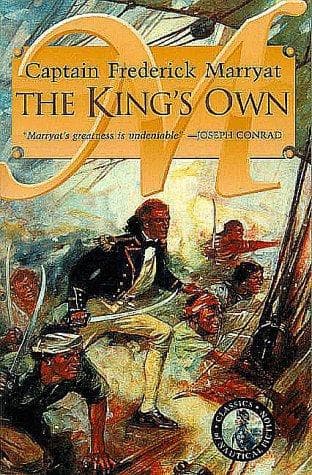
Great Britain -- History, Naval -- 18th century -- Fiction; Nore Mutiny, 1797 -- Fiction
"What will become of him?" cried Peters with energy. "Why, he shall
retrieve his father's faults--wash out the stain in his father's
character. He shall prove as liege a subject as I have been a
rebellious one. He shall as faithfully serve his country as I have
shamefully deserted it. He shall be as honest as I have been false; and
oh, may he be as prosperous as I have been unfortunate--as happy as I
have been miserable. Come hither, boy. By the fond hopes I entertain
of pardon and peace above--by the Almighty, in whose presence I must
shortly tremble, I here devote thee to thy country--serve her bravely
and faithfully. Tell me, Willy, do you understand me, and will you
promise me this?"
The boy laid his head upon his father's shoulder, and answered in a low
tone--"I will;" and then, after a short pause, added, "but what are they
going to do with you, father?"
"I am going to die for my country's good, my child. If God wills it,
may you do the same, but in a more honourable manner."
The boy seemed lost in thought, and, after a short time, quitted his
father's side, and sat down on the deck by his mother, without speaking.
Adams rose, and taking him up, said, "Mayhap you have that to talk of
which wants no listeners. I will take Willy with me, and give him a
little air before I put him in his hammock. It's but a close hole,
this. Good night to you both, though I'm afeard that's but a wish."
But a wish indeed!--and it was the last that was ever to close upon the
unhappy Peters. The next morning was appointed for his execution.
There are scenes of such consummate misery, that they cannot be
portrayed without harrowing up the feelings of the reader,--and of these
the climax may be found in a fond wife, lying at the feet of her husband
during the last twelve hours of his mortal career. We must draw the
curtain.
And now, reader, the title of this work, which may have puzzled you,
will be explained: for, intelligible as it may be to our profession, it
may be a mystery to those who are not in his Majesty's service. The
broad-headed arrow was a mark assumed at the time of the Edwards (when
it was considered the most powerful weapon of attack), as distinguishing
the property of the King; and this mark has been continued down to the
present day. Every article supplied to his Majesty's service from the
arsenals and dockyards is thickly studded with this mark; and to be
found in possession of any property so marked is a capital offence, as
it designates that property to be the _King's own_.
Public-domain text, read in full here on John Shaqi.
Reviews
Reviews
No reviews yet
Be the first to share your thoughts on this work.
Join the Discussion
Join the discussion
Sign in to leave a comment or review.
Sign InorCreate an account