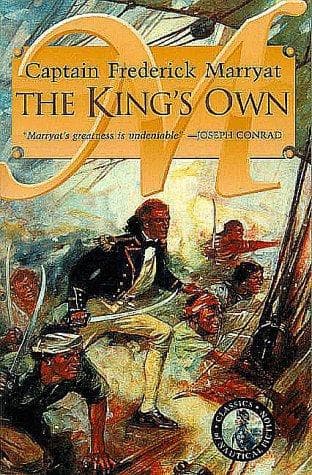
Great Britain -- History, Naval -- 18th century -- Fiction; Nore Mutiny, 1797 -- Fiction
"Merciful Heaven!" exclaimed the man of religion, as he sat down to
recover from the shock he had received.--"Unfortunate boy!"
The admiral turned round, astonished at the demeanour of the clergyman,
and (it would appear) as if his conscience had pressed him hard, and
that he was fearful that his cruel wish, expressed but a few minutes
before, had been realised. He turned pale, but asked no questions.
After a short time the vicar rose, and, with a countenance of more
indignation than the admiral or others had ever seen, thus addressed
him:--
"The time may come, sir,--nay, I prophesy that it _will_ come, when the
contents of this letter will cause you bitterly to repent your cruel and
unnatural conduct to your son. The letter itself, sir, I cannot intrust
you with. In justice to others, it must not be put into your hands; and
after your attempt to commit it to the flames, and your observation that
I might read and _keep it too_, I feel justified in retaining it. A
copy of it, if you please, I will send you, sir."
"I want neither copy nor original, nor shall I read them if you send
them, good sir," answered the admiral, pale with anger.
"Fare you well, then, sir. May God turn your heart!"
So saying, the vicar left the room with a determination not to enter it
again. His first inquiry was for the person who had brought the letter,
and he was informed that he still waited in the hall. It was old Adams,
who had obtained leave of absence for a few days, that he might fulfil
the last request of Peters. The clergyman here received a second shock,
from the news of the death of poor Ellen, and listened with the deepest
interest to Adams's straightforward account of the whole catastrophe.
The first plan that occurred to the vicar was to send for the child, and
take charge of him himself; but this was negatived, not only by Peters's
letter, but also by old Adams, who stated his determination to retain
the child until claimed by legal authority. After mature deliberation,
he considered that the child would be as much under an Allseeing Eye on
the water as on the land, and that, at so early an age, he was probably
as well under the charge of a trustworthy old man like Adams, as he
would be elsewhere. He therefore requested Adams to let him have
constant accounts of the boy's welfare, and to apply to him for any
funds that he might require for his maintenance; and, wishing the old
man farewell he set off for the vicarage, communing with himself as to
the propriety of keeping the circumstance of the boy's birth a secret,
or divulging it to his grandfather, in the hopes of eventually inducing
him to acknowledge and to protect him.
CHAPTER SEVEN.
To the seas presentlye went our lord admiral,
With knights couragious and captains full good;
The brave Earl of Essex, a prosperous general,
With him prepared to pass the salt flood.
Public-domain text, read in full here on John Shaqi.
Reviews
Reviews
No reviews yet
Be the first to share your thoughts on this work.
Join the Discussion
Join the discussion
Sign in to leave a comment or review.
Sign InorCreate an account