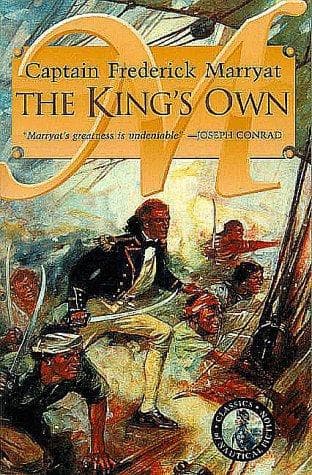
Great Britain -- History, Naval -- 18th century -- Fiction; Nore Mutiny, 1797 -- Fiction
At Plymouth speedilye took they ship valiantlye,
Braver ships never were seen under sayle,
With their fair colours spread, and streamers o'er their head:
Now, bragging foemen, take heed of your tayle.
OLD BALLAD, 1596.
Many and various were the questions that were put by our little hero to
Adams and others, relative to the fate of his parents. That they were
both dead was all the information that he could obtain; for, to the
honour of human nature, there was not one man in a ship's company
composed of several hundred, who had the cruelty to tell the child that
his father had been hanged. It may, at first, appear strange to the
reader, that the child himself was not aware of the fact, from what he
had witnessed on the morning of execution; but it must be recollected
that he had never seen an execution before, and had therefore nothing
from which to draw such an inference. All he knew was, that his father
was on the quarter-deck, with a night-cap on, and that he told him that
he was going to sleep. The death of his mother, whose body he was not
permitted to see, was quite as unintelligible, and the mystery which
enveloped the whole transaction added no little to the bereavement of
the child, who, as I have before stated, from his natural talent and
peculiar education was far more reflective and advanced than children
usually are.
Adams returned to his little charge with pleasure: he had now a right to
adopt the child, and consider him as his own. In the ship, the boy was
such an object of general sympathy, that not only many of the men, but
some of the officers, would gladly have taken him, and have brought him
up. The name of his father was, by general consent, never mentioned,
especially as Adams informed the officers and men that Peters had been a
"_purser's name_," adopted by the child's father, and that, although the
clergyman had stated this, he had not intrusted him with the real name
that the child was entitled to bear. As, therefore, our little hero was
not only without parents, but without name, he was re-christened by
Adams by the cognomen of the "King's Own," and by that title, or his
Christian name, Willy, was ever afterwards addressed, both by officers
and men.
There is an elasticity supplied to the human mind by unerring Wisdom,
that enables us, however broken down by the pressure of misfortune, to
recover our cheerfulness after a while, and resign ourselves to the
decrees of Heaven. It consoles the widow--it supports the bereaved
lover, who had long dwelt upon anticipated bliss--it almost reconciles
to her lot the fond and forsaken girl, whose heart is breaking.
Public-domain text, read in full here on John Shaqi.
Reviews
Reviews
No reviews yet
Be the first to share your thoughts on this work.
Join the Discussion
Join the discussion
Sign in to leave a comment or review.
Sign InorCreate an account