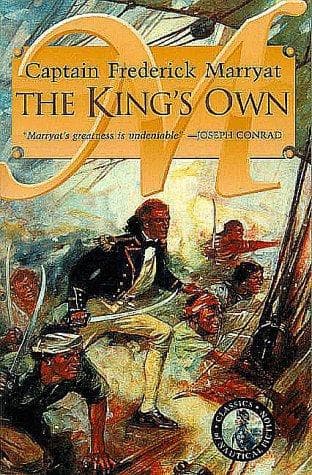
Great Britain -- History, Naval -- 18th century -- Fiction; Nore Mutiny, 1797 -- Fiction
Unusually oppressed as Willy was, with the loss of those to whom he had
so fondly clung from his birth, in a few months he recovered his wonted
spirits, and his cheeks again played with dimples, as his flashing eye
beamed from under his long eyelashes. He attached himself to the old
quarter-master, and seldom quitted him--he slept in his hammock, he
stood by his side when he was on deck, at his duty, steering the ship,
and he listened to the stories of the good old man, who soon taught him
to read and write. For three years thus passed his life; at the end of
which period he had arrived at the age of nine years.
After a long monotony of blockade service, the ship was ordered to hoist
the flag of a commodore, who was appointed to the command of an
expedition against the western coast of France, to create a diversion in
favour of the Vendean chiefs. Captain A---, whether it was that he did
not like to receive a superior officer on board of his ship, or that he
did not admire the service upon which she was to be employed, obtained
permission to leave his ship for a few months, for the restoration of
his health, to the great joy of the officers and crew; and an acting
captain of well-known merit, was appointed in his stead.
The squadron of men-of-war and transports was collected, the commodore's
flag hoisted, and the expedition sailed with _most secret_ orders,
which, as usual, were as well known to the enemy, and everybody in
England, as they were to those by whom they were given. It is the
characteristic of our nation, that we scorn to take any unfair
advantage, or reap any benefit, by keeping our intentions a secret. We
imitate the conduct of that English tar, who, having entered a fort, and
meeting a Spanish officer without his sword, being providentially
supplied with two cut-lasses himself, immediately offered him one, that
they might engage on fair terms.
The idea is generous, but not wise. But I rather imagine that this want
of secrecy arises from all matters of importance being arranged by
cabinet councils. In the multitude of counsellors there may be wisdom,
but there certainly is not secrecy. Twenty men have probably twenty
wives, and it is therefore twenty to one but the secret transpires
through that channel. Further, twenty men have twenty tongues; and much
as we complain of women not keeping secrets, I suspect that men deserve
the odium of the charge quite as much, if not more, than women do. On
the whole, it is forty to one against secrecy, which, it must be
acknowledged, are long odds.
Public-domain text, read in full here on John Shaqi.
Reviews
Reviews
No reviews yet
Be the first to share your thoughts on this work.
Join the Discussion
Join the discussion
Sign in to leave a comment or review.
Sign InorCreate an account