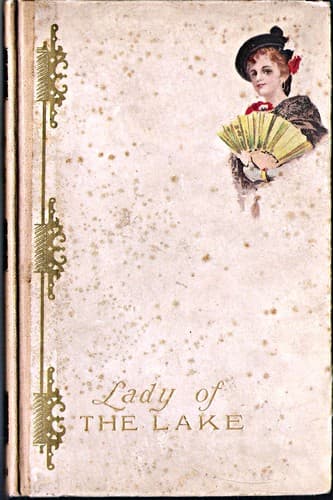
Arthurian romances; Lady of the Lake (Legendary character) -- Romances
"The harp and chairschoes are now only heard of in the Highlands in
ancient song. At what period these instruments ceased to be used, is not
on record; and tradition is silent on this head. But, as Irish harpers
occasionally visited the Highlands and Western Isles till lately,
the harp might have been extant so late as the middle of the present
century. Thus far we know, that from remote times down to the present,
harpers were received as welcome guests, particularly in the Highlands
of Scotland; and so late as the latter end of the sixteenth century, as
appears by the above quotations, the harp was in common use among
the natives of the Western Isles. How it happened that the noisy and
inharmonious bagpipe banished the soft and expressive harp, we cannot
say; but certain it is, that the bagpipe is now the only instrument
that obtains universally in the Highland districts' (Campbell's Journey
through North Britain. London, 1808, 4to, i. 175).
"Mr. Gunn, of Edinburgh, has lately published a curious Essay upon the
Harp and Harp Music of the Highlands of Scotland. That the instrument
was once in common use there, is most certain. Cleland numbers an
acquaintance with it among the few accomplishments which his satire
allows to the Highlanders:--
'In nothing they're accounted sharp,
Except in bagpipe or in harm.'"
624. Soldier, rest! etc. The metre of this song is trochaic; that is,
the accents fall regularly on the odd syllables.
631. In slumber dewing. That is, bedewing. For the metaphor, cf.
Shakespeare, Rich. III. iv. 1. 84: "the golden dew of sleep;" and J. C.
ii. 1. 230: "the honey-heavy dew of slumber."
635. Morn of toil, etc. The MS. has "noon of hunger, night of waking;"
and in the next line, "rouse" for reach.
638. Pibroch. "A Highland air, suited to the particular passion which
the musician would either excite or assuage; generally applied to those
airs that are played on the bagpipe before the Highlanders when they go
out to battle" (Jamieson). Here it is put for the bagpipe itself. See
also on ii. 363 below.
642. And the bittern sound his drum. Goldsmith (D. V. 44) calls the bird
"the hollow-sounding bittern;" and in his Animated Nature, he says that
of all the notes of waterfowl "there is none so dismally hollow as the
booming of the bittern."
648. She paused, etc. The MS. has "She paused--but waked again the lay."
655. The MS. reads: "Slumber sweet our spells shall deal ye;" and in
657:
"Let our slumbrous spells| avail ye
| beguile ye."
657. Reveille. The call to rouse troops or huntsmen in the morning.
669. Forest sports. The MS. has "mountain chase."
672. Not Ellens' spell. That is, not even Ellen's spell. On the passage,
cf. Rokeby, i. 2:
"Sleep came at length, but with a train
Of feelings true and fancies vain,
Mingling, in wild disorder cast,
The expected future with the past."
Public-domain text, read in full here on John Shaqi.
Reviews
Reviews
No reviews yet
Be the first to share your thoughts on this work.
Elsewhere in the archive
Join the Discussion
Join the discussion
Sign in to leave a comment or review.
Sign InorCreate an account