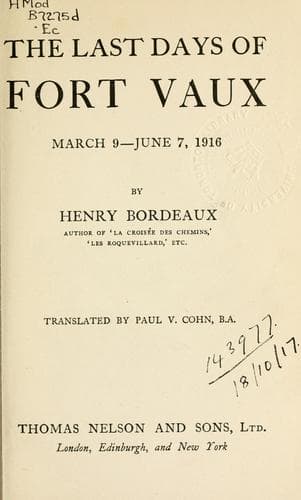
The Last Days of Fort Vaux, March 9-June 7, 1916Bordeaux, Henry
History
The Last Days of Fort Vaux, March 9-June 7, 1916
Bordeaux, Henry
Verdun, Battle of, Verdun, France, 1916; World War, 1914-1918 -- Personal narratives
“That’ll be a tough job. Those birds like to settle in strange nests.
Before you can look round, they have dug themselves in. Tell me
anything else you know.”
The fort whispers to itself, “And even what you don’t know.” For stones
have experience, and therefore irony.
“Well, the Iron Division is there. Others, too, which are unfamiliar
to me. At Douaumont village there is a colonel who says, ‘So long as I
have breath in my body, the Boche won’t get in.’”
“It’s always risky to say things like that.”
“The Boches have not got in. They were stopped in front of the village.
Our machine-guns mowed them down there by hundreds.”
“And that colonel is still alive?”
“Yes. He was picked up, and I met him. He has a calm face and fiery
eyes. He never raises his voice, yet you hear that voice inside you,
controlling you and making you march. It was in his regiment that in
Brulé Wood, towards St. Mihiel, an adjutant shouted, ‘Arise, ye dead!’”
“And did the dead answer?”
“What would you expect them to answer?”
“The dead always answer when they are called. The dead have made the
nation which the living carry on. It is the dead who have built me. And
the dead are bone of thy bone and flesh of thy flesh, as they are stone
of my stone.”
The sentries, however, have been doubled. Since the enemy is at
Douaumont, since he has descended into the Woevre, he is likely to
attempt the assault any day. On March 8 he attacks Vaux village; on the
9th and 10th he hurls himself against both village and fort.
The fort, on its hill, resists the storm, like a ship battered by the
waves.
Above the battlefield, in the plains of the air, electric waves started
from afar are recorded in signs at the receivers and by wireless
telegraphy transmit the war news to headquarters, to the nation, to the
whole world. They cross each other like flocks of migrant birds, and
engage in mysterious conflicts.
On February 26 Germany lets loose a first raven, bearing this message:
“To the east of the Meuse, in the presence of His Majesty the Emperor
and King, we achieved some notable gains. Our gallant troops seized
the heights to the south-east of Louvemont, the village of Louvemont
and the fortified position farther to the east. With a vigorous push
forward some Brandenburg regiments reached the village and the armoured
fort of Douaumont, which they took by storm. In the Woevre, the enemy’s
resistance was shattered on the whole front in the Marchéville district
(to the south of the Paris-Metz road). Our troops are pressing hard
upon the enemy in his retreat.”
Public-domain text, read in full here on John Shaqi.
Reviews
Reviews
No reviews yet
Be the first to share your thoughts on this work.
Join the Discussion
Join the discussion
Sign in to leave a comment or review.
Sign InorCreate an account