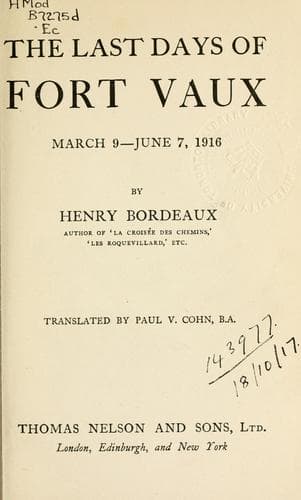
The Last Days of Fort Vaux, March 9-June 7, 1916 — John Shaqi
The Last Days of Fort Vaux, March 9-June 7, 1916Bordeaux, Henry
History
The Last Days of Fort Vaux, March 9-June 7, 1916
Bordeaux, Henry
Verdun, Battle of, Verdun, France, 1916; World War, 1914-1918 -- Personal narratives
No assault was made upon Fort Douaumont; it was taken by surprise.
All the German attacks on Douaumont village were a complete failure.
The Woevre was evacuated by a strategic manœuvre, and the enemy, in a
distrustful mood, only ventured upon it with considerable qualms, had
to stop in front of Manheulles on February 27, and was unable to enter
Fresnes until March 7. But how much better it looks in a communiqué
to represent those worthy Brandenburgers as scaling the glacis of a
fort under fire, putting ladders to the counterscarp, climbing to the
assault, crossing the ditches, happy to conquer or die under the benign
gaze of His Majesty the Emperor and King, who was no doubt present at
the ceremony with a golden helmet on his head and a golden sword in his
hand! A taste for romantic visions prevails in the German Great General
Staff.
The second raven is more daring. It is sent forth on March 9 and
announces to an eagerly listening world the capture of Fort Vaux. It is
the pendant to Douaumont: a diptych offered to the nations.
“To the east of the river (Meuse), in order to shorten the connections
to the south of Douaumont with our Woevre lines, the village, the
armoured fort of Vaux, and the numerous neighbouring fortifications
belonging to the enemy were seized after the way had been vigorously
cleared by our artillery, in a brilliant night attack by the Posen
reserve regiments, Nos. 6 and 19, under the direction of Infantry
General von Guretsky-Cornitz, Commander of the 9th Reserve Division.”
How could the attentive world dare to cast doubts on the veracity of
a wireless message so definite and so inspiring? The day and hour are
given, the numbers of the regiments, the name and title of the General
who held command. Such details cannot be invented. Detail is the strong
point of the German method. Learning is nothing but a knowledge of
details. History? Details or a series of detailed statements.
Has Fort Vaux been taken? How should it not have been, seeing that it
is General von Guretsky-Cornitz, commanding the 6th and 19th Posen
regiments, who took it? Obviously, on the one side, there is the
General with his two regiments, and on the other there is Fort Vaux.
How could Fort Vaux fail to lodge the General and his two regiments
with him? “Is that trunk ours?” asked Robert Macaire of the faithful
Bertrand. And he at once concluded: “It must be ours.” “Is the fort
ours?” the Boche asks himself. “It must be ours.” And he at once
announces the fact.
Public-domain text, read in full here on John Shaqi.
Reviews
Reviews
No reviews yet
Be the first to share your thoughts on this work.
Join the Discussion
Join the discussion
Sign in to leave a comment or review.
Sign InorCreate an account