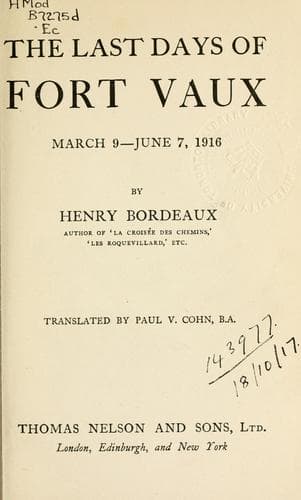
The Last Days of Fort Vaux, March 9-June 7, 1916Bordeaux, Henry
History
The Last Days of Fort Vaux, March 9-June 7, 1916
Bordeaux, Henry
Verdun, Battle of, Verdun, France, 1916; World War, 1914-1918 -- Personal narratives
The track that we are now pursuing is not so hard to follow, but in
other ways it is beset with terrors. Every moment we have to walk
across bodies flung across it. At every ten or twelve yards, soon at
every five or six paces, we are compelled to stride over a corpse, or
even bunches of corpses, some slashed and torn, others in a running
posture as if they had been overtaken while in full activity. The light
of the moon softens the horror of their wounds without altogether
veiling it. Many of them belong to the scouts who ensure connections,
carry orders, show routes to be followed. In this war, where men vie
with one another in every kind of heroism, we must pay a special
tribute to those soldiers who, while their comrades dig themselves in
as best they can under the hurricane of fire, run about in the open in
order to make up for signalling difficulties or for the breaking of
telephone wires. Thanks to these men, efforts are co-ordinated and an
understanding is maintained at all points of the front, so that the
chain of unity holds together. If one falls, there is at once another
to take his place. The remainder are always ready; they even offer
their services before their turn comes. Prepared to go upon the most
perilous errands, they form a mobile guard round their chief; they are
the projecting rays of his brain, which, through them, directs men’s
wills from afar and draws up or corrects the plans of an operation.
Those who have fallen there, or at any rate some of them, seem to have
assumed in death the attitude of those antique youths who handed on to
each other the sacred torch in the race. Is it the moon that helps me
to see these broken statues? Shall I once more find such marble visions
by daylight? The crude light of day does not do justice to the beauty
of death.
The soldier who acts as our guide marches at a good rate. He gives the
signal to stop when a shell falls too close to us, or when the cadence
of the explosions points to a systematic curtain fire. He does not pick
out the places for halting, and makes us come to a standstill suddenly
with corpses under our very noses, lucky indeed if our faces are not
splashed with fragments of flesh crushed once more by that ghastly
pestle.
Public-domain text, read in full here on John Shaqi.
Reviews
Reviews
No reviews yet
Be the first to share your thoughts on this work.
Join the Discussion
Join the discussion
Sign in to leave a comment or review.
Sign InorCreate an account