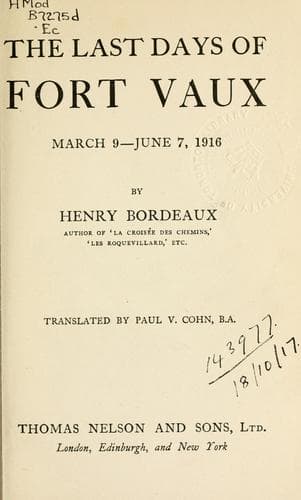
The Last Days of Fort Vaux, March 9-June 7, 1916 — John Shaqi
The Last Days of Fort Vaux, March 9-June 7, 1916Bordeaux, Henry
History
The Last Days of Fort Vaux, March 9-June 7, 1916
Bordeaux, Henry
Verdun, Battle of, Verdun, France, 1916; World War, 1914-1918 -- Personal narratives
But why does he stop at this moment? Just now the tempo seems to be
slackening. Surely we ought to take advantage of this respite. Ah,
there he is, stripping a dead soldier! He half-raises him and takes off
one by one the straps which the man wears in banderole. In this way he
unfastens four or five water-bottles, each holding four pints. These
he unscrews and sniffs at in turn, not without anxiety on account of
the shells which might interrupt him at his task. His face lights up:
the water is drinkable. The man whom he has stripped so methodically
carried a supply of water for replenishment, and water on this dried-up
tableland is as precious as in the desert. The place from which it is
drawn is at the foot of the hillside: you are not sure of getting there
or of coming back. At the fort, so many lips are thirsty for fresh
water!
The guide, with his water-bottle straps round his waist, hastily
resumes his journey, drawing us after him as a roebuck draws a pack of
hounds.
At this pace we pass a caravan of porters loaded with a consignment of
grenades. They are marching as fast as their burden allows them, under
the rain of steel. The only means of transport here is the human back.
Poor little men, whose heart is still the greatest of all military
forces! “It is a scientific war,” people have declared. “Victory lies
with munitions. It is the munitions that crush and destroy everything.”
Well, when the artillery thinks to have destroyed everything, the human
will still offers a wall of flesh as a resistance: men have endured
everything--fire, hunger, cold, and thirst--and still they rise out of
the shattered soil. No war will be found to have given such examples of
the superiority of man to the machine.
The countryside looks all scorched and burnt. The lava of a volcano,
the shocks of an earthquake, all the cataclysms of nature would not
have flayed it more unmercifully. It is a chaos without a name, a
circle in Dante’s Inferno. I rack my memory for parallel scenes;
perhaps certain Alpine solitudes where the glaciers have withdrawn or
the moraines alternate with precipices--solitudes that have never heard
the song of a bird or felt the contact of a living creature.
The craters meet and open like the yawning mouths of volcanoes. Broken
branches, scattered boulders, detritus of all kinds and shreds of human
flesh are mingled. A nameless stench rises from the tortured soil.
Public-domain text, read in full here on John Shaqi.
Reviews
Reviews
No reviews yet
Be the first to share your thoughts on this work.
Join the Discussion
Join the discussion
Sign in to leave a comment or review.
Sign InorCreate an account