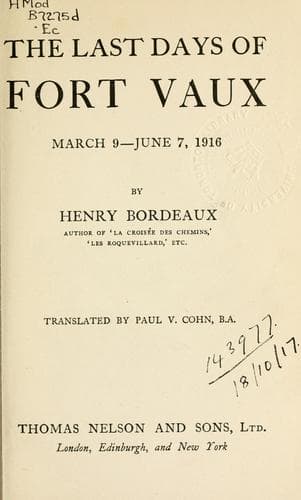
The Last Days of Fort Vaux, March 9-June 7, 1916 — John Shaqi
The Last Days of Fort Vaux, March 9-June 7, 1916Bordeaux, Henry
History
The Last Days of Fort Vaux, March 9-June 7, 1916
Bordeaux, Henry
Verdun, Battle of, Verdun, France, 1916; World War, 1914-1918 -- Personal narratives
In front of us rises a wall covered with earth. There are gashes in
it, and through these cracks the stones have fallen into the ditch.
On the whole, however, it has borne the avalanche without flinching.
Three-quarters of the vaulted door is masked by a mass of concrete
dislodged by a 380 or 420 mm. shell. It is like the cave of the
Cyclops, which had a rock for its door and which received Ulysses and
his companions. Past the open space we scurry along quickly, for it
is specially favoured by the enemy’s artillery, as the corpses, more
numerous here, bear witness. Even so did the Cyclops kill all strangers.
What is my surprise at finding the interior of the fort undamaged! It
must have been built of solid materials to resist such a hammering.
The staircase, the passages, the rooms are crammed. A curious sight is
the swarm of men under the electric lights: sleepers lying in every
conceivable pose, some stretched out anywhere, others curled up so as
to occupy the least possible space, all impervious to noises, refusing
to wake up, enjoying the delicious relaxation of sleep removed from
danger; fatigue parties making their way with difficulty through
the crush; guards going on or returning from duty; wounded men with
white bandages on their wounds; isolated squads looking for their
company. One guesses the cause of this confusion, which will have to be
remedied. The fort, on its tableland, plays the part of those mountain
refuges where lost caravans come to find shelter from the storm. It
is a haven of safety; he who succeeds in crossing the danger-zone can
breathe freely under the arched vaults.
Little by little the march past becomes more orderly, and organization
is introduced into the mob. The right is reserved for those coming
in, the left for those going out. Here is the ambulance, there is the
guard-room, there is the orderly-room.
On our arrival our guide is received with enthusiasm. His array of
water-bottles earns him an ovation. Thirst is working havoc here. The
nearest source of water is in the Fontaines ravine, and that ravine is
constantly peppered with shot. Yet men risk their skins to go and get
a drink. Water creates such pitiful mirages. In the shapeless furrows
which serve them as shelters, the troops, with parched lips, wait for
water with feverish impatience; they are reduced sometimes to drinking
the tainted water that stagnates in the shell-holes, and to other
strange expedients. Who will ever tell of all the horrors endured for
Verdun and for that France which is behind Verdun?
A soldier, somewhat elderly, no doubt a Territorial, comes in with
rolls of bread on his back. He is near collapsing; he pants, the sweat
pours off him in big drops, his face is white as chalk.
“You are alone?” asks the sergeant of the guard. “Where is the rest of
the fatigue?”
Public-domain text, read in full here on John Shaqi.
Reviews
Reviews
No reviews yet
Be the first to share your thoughts on this work.
Join the Discussion
Join the discussion
Sign in to leave a comment or review.
Sign InorCreate an account