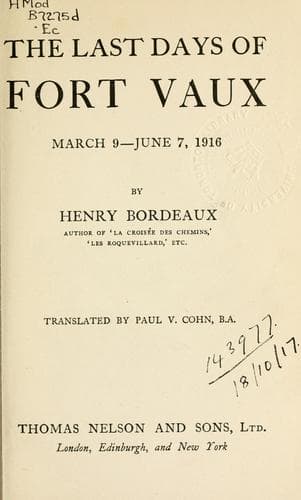
The Last Days of Fort Vaux, March 9-June 7, 1916Bordeaux, Henry
History
The Last Days of Fort Vaux, March 9-June 7, 1916
Bordeaux, Henry
Verdun, Battle of, Verdun, France, 1916; World War, 1914-1918 -- Personal narratives
One is dressed in a sky-blue uniform, like the rank and file, like
every one. His tanned face, every expression of which I know well--it
combines great kindliness with an intellect always in search of
certainty and precision--betrays the secret that racks him. He is in
command of the most exposed, the most frequently attacked, the most
difficult sector of the whole front of the army which covers Verdun,
and, at this moment, of the entire front of the French Army. It touches
Fort Douaumont and guards Fort Vaux. He lives heart and soul with his
men, who are down there in the whirlwind of steel, holding out against
all odds. He shares the burden of their hardships and their exertions.
He is consumed with anxiety to know. The desire to conquer is fretting
his body. His features bear ample witness to the fire that burns
within.
The other, tall and massively built, wears the old-fashioned uniform,
to whose colours the eye is unaccustomed: red trousers, black tunic,
red cap, with a double band of oak leaves.[1] He seems to be gazing at
an invisible point above the head of the person whom he is addressing.
While listening, he seems to be under the spell of some inner dream. He
wears a thick white moustache. His eyes have a far-away look. Are the
realities of the present enough for them, or do they need a map of the
world to satisfy them?
[1] In the French Army a double band of oak leaves round the
cap denotes a General commanding a division.--_Translator’s
Note._
The two have stopped near our group. The senior General says to his
companion, as if putting an end to their conversation--a conversation
in which up to now he has scarcely uttered a word:
“All is well, and now you need feel no uneasiness.”
The other seems to be surprised. He is in a state of deadly anxiety,
and he is urged to be calm! He is apparently waiting for something
more, but this is really the end of the discussion. A motor-car has
been summoned. He salutes and goes off.
“You need feel no uneasiness.” One of my comrades, who in his brief
leisure moments is rereading Tolstoi’s _War and Peace_, and is blessed
with a portentous memory, reminds me of the passage where Prince André
Bolkonsky, aide-de-camp to General Bagration, comes to report to his
chief what he has been able to find out about the forces that are
threatening the Russian Army:
“While listening to him, Prince Bagration stared in front of him, and
Prince André, while studying the strongly marked features of that face
whose eyes were half-closed, wandering, and sleepy, asked himself, with
an uneasy curiosity, what thoughts, what feelings were hidden behind
that impenetrable mask?”
(The eyes, here, are also staring, but at some point far away, as if to
see beyond the horizon of Verdun.)
“All is well,” says Bagration simply, as if what he has just heard had
been anticipated by him.
And what he has just heard is the menace that weighs upon his army.
Public-domain text, read in full here on John Shaqi.
Reviews
Reviews
No reviews yet
Be the first to share your thoughts on this work.
Join the Discussion
Join the discussion
Sign in to leave a comment or review.
Sign InorCreate an account