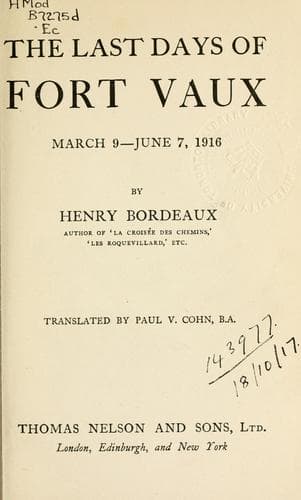
The Last Days of Fort Vaux, March 9-June 7, 1916Bordeaux, Henry
History
The Last Days of Fort Vaux, March 9-June 7, 1916
Bordeaux, Henry
Verdun, Battle of, Verdun, France, 1916; World War, 1914-1918 -- Personal narratives
What our General has just heard has caused him no anxiety. He has
answered, “All is well,” as if the menace could in no way alter his
plans. Later on this recollection, throwing light on the phrase which
had almost shocked me, was to assume a singularly precise outline in my
mind, and to widen like those ripples which are formed in water when
a stone is flung in and grow larger and larger until they reach the
banks....
IV
THE FIRST FIGHTS ROUND VAUX
(MARCH 9, 10, 11)
From the road, I see soldiers stretched out on the grass, basking in
the spring sun, fishing in the river, or playing ball like schoolboys.
Motor-omnibuses picked them up suddenly, not far from the Verdun
battlefield, to carry them to this abode of rustic peace. They do not
even hear the guns any longer. It is strange to contrast this bucolic
scene with the fiery furnace of Vaux.
Among the valleys of the Meuse region, which are generally rather grim
and gloomy, the valley of La Saulx is the most smiling, the richest in
flowers, the most attractive. A crystal-clear brook waters its meadows
and seems, with all its meanderings, to run an endless course. Here
is Montiers-sur-Saulx, where the 303rd Brigade is billeted for a few
days. The Sire de Joinville lived there; in the archives of the town
hall one may read the charter by which he allowed the villagers the use
of a part of his forest. Jeanne d’Arc went through it, dreaming of
her mission. The troops in blue-grey caps who stroll round the central
square where the military band plays are not so very different, in
their bright uniforms, from the men-at-arms of bygone days.
In little groups the men walk about, light their pipes, and chat with
the natives. The whole scene looks like a day of peace-time manœuvres,
and the very gait of the men is so brisk that one might fancy them to
be fresh troops recently detrained here and ready to proceed again to
the front.
Yet the sentry who is mounting guard at the town hall wears a cap that
has been pierced by a bullet. Other caps are indented or knocked out of
shape. More than one of these peaceful ramblers has his head bandaged
or shows some scar on his face. The colonel in command of the brigade
has on his cheek a sabre-cut on which the blood has just dried--a
trifling wound which has not been deemed worthy of dressing.
These are the men who broke the back of the German assaults on the
village and fort of Vaux on March 8, 9, and 10. They can scarcely
remember that they forced the enemy to retreat; they are too much
occupied with forgetting their miseries--the cold, the snow, the lack
of sleep, the long hours they spent crouching down in rifle-pits, their
lost comrades, the continual presence of death during the bombardment
which shatters men’s nerves and stuns their brains.
Public-domain text, read in full here on John Shaqi.
Reviews
Reviews
No reviews yet
Be the first to share your thoughts on this work.
Join the Discussion
Join the discussion
Sign in to leave a comment or review.
Sign InorCreate an account