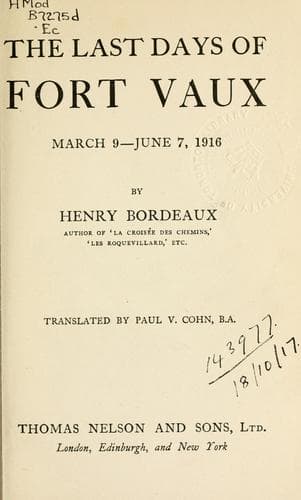
The Last Days of Fort Vaux, March 9-June 7, 1916Bordeaux, Henry
History
The Last Days of Fort Vaux, March 9-June 7, 1916
Bordeaux, Henry
Verdun, Battle of, Verdun, France, 1916; World War, 1914-1918 -- Personal narratives
The commander of the garrison is Major Raynal of the 96th Infantry
Regiment. Though wounded, he refused to wait until he was cured before
returning to duty. Born at Bordeaux, where his father was a bootmaker,
on March 7, 1867, of a family that originally came from Montauban, the
future defender of Vaux was educated at the Angoulême _lycée_, then
enlisted in the 123rd Regiment on March 15, 1885. Five years later he
entered the military school of St. Maixent, and left it as a second
lieutenant on April 1901, having gained the first place out of 328
candidates. A Captain at the outbreak of the war, he was appointed
Battalion Commander on August 24, 1914. How he led his battalion may be
shown by a quotation from an Army order: “Commanding the advanced guard
of his regiment on September 14, 1914, and getting into touch with the
strongly entrenched enemy at a brief distance from early in the morning
onwards, he at once took up his position on the tactical points, and
by strenuous efforts kept his battalion there under fire from German
rifles, machine-guns, and heavy artillery. Seriously wounded in the
afternoon, he retained command of his battalion, staying in the first
line in order personally to direct the fighting, in close and difficult
country, until his loss of blood became so great that he was compelled
to retire.” At Crouy, on September 14, a bullet from a machine-gun
ripped up his chest on the left side. He had been a Knight of the
Legion of Honour since July 11, 1900, and was promoted Officer[3] on
January 11, 1916, with the following description:
[3] There are five grades of the _Légion d’honneur_: (1)
_Chevalier_, (2) _Officer_, (3) _Commandeur_, (4)
_Grand-Officer_, (5) _Grand-Croix_.--_Translator’s Note._
“An admirable officer of high character and military abilities. Badly
wounded on September 14, 1914, he returned to the front, where he has
continued to render signal service: was very badly wounded once more on
October 3, 1915, when he was coolly and methodically proceeding to a
reconnaissance of the sector in which his battalion was posted.”
His second wound was received at Tahure, in Champagne; a splinter from
a shell in his abdomen broke the top of his hip-bone before passing out
through his back.
Not being sufficiently recovered to take up an active command with any
confidence, he asked for a post where there would be little moving
about and plenty of danger. “You will be given command of a Verdun
fort.” The Major pulls a wry face: he would prefer open country. “Then
let it be the most exposed fort.” “Which one?” “Vaux, obviously.” “Very
well, then, go to Vaux.”
Public-domain text, read in full here on John Shaqi.
Reviews
Reviews
No reviews yet
Be the first to share your thoughts on this work.
Elsewhere in the archive
Join the Discussion
Join the discussion
Sign in to leave a comment or review.
Sign InorCreate an account