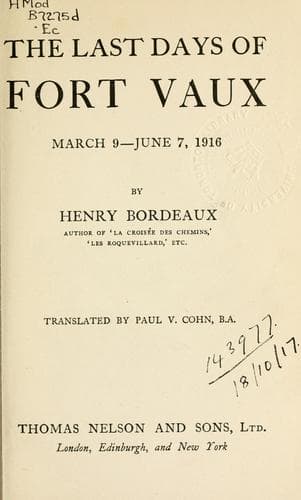
The Last Days of Fort Vaux, March 9-June 7, 1916Bordeaux, Henry
History
The Last Days of Fort Vaux, March 9-June 7, 1916
Bordeaux, Henry
Verdun, Battle of, Verdun, France, 1916; World War, 1914-1918 -- Personal narratives
On the 25th, the garrison was cheered by a stroke of good fortune of
which it was at once informed. A German motor-car, which was carrying
the General Staff orders, while running along the Étain road, went
astray over the distances, and on the evening of the 24th came into our
lines and was there captured. Our command, into whose hands the enemy’s
plans had so luckily fallen, gave orders for a surprise assault on the
left flank of the 35th Division of the Landwehr and of the 16th Corps,
which formed the left wing of the Crown Prince’s Army. The former,
throwing down their rifles, fled as far as St. Privat, and the latter
beat a hasty retreat to Bouvillers. It is possible that this Étain
fight, a little-known episode of the first battles, checkmated a rush
attack upon Verdun.
Nevertheless it was necessary to give up the pursuit on the night
of August 25-26, in order to remain in close co-ordination with the
movements of the neighbouring army and to pass along the left bank of
the Meuse, leaving reserve divisions to guard the right bank on the
line Ornes-Fromezey-Herméville.
What Fort Vaux then saw go by at the foot of its slopes is a sight
which those who witnessed it will never forget. In after years they
will tell it to their children and their children’s children, that the
memory may be kept green in each generation.
Along the road from Étain to Verdun, seeking a haven of refuge in
the old fortress which, more than once in the course of centuries,
must have sheltered the inhabitants of the Meuse valley against the
onrush of Germanic hordes, came a hurried throng of two-wheeled and
four-wheeled vehicles, of cyclists wheeling the machines which they had
no room to mount, of wheelbarrows, of pushcarts, of pedestrians, of
dogs, of cattle. Each took with him his most treasured possessions or
what he had hastily snatched up in his house. On the carriages many had
piled mattresses, trunks, quilts, provisions, furniture, and on the top
of all these were the old people, the sick, and the children. Yet these
three classes could not always find room on the vehicles. Among those
who trudged on foot were the blind and the halt, women carrying their
babies, little ones with a doll or a bird-cage in their hands. Some of
them, their legs being shaky or not long enough, were too weary to drag
themselves along. Behind these terror-stricken fugitives, the villages
were in flames. They turned night into day over the whole countryside.
Little by little the fire drew nearer. Now it is Rouvre that flares up,
now Étain.
Public-domain text, read in full here on John Shaqi.
Reviews
Reviews
No reviews yet
Be the first to share your thoughts on this work.
Join the Discussion
Join the discussion
Sign in to leave a comment or review.
Sign InorCreate an account