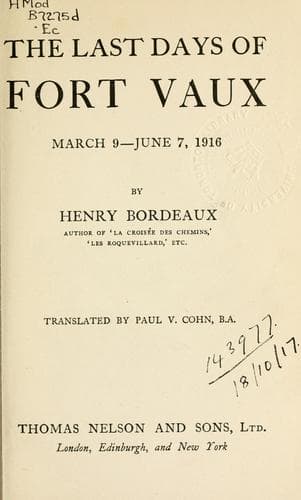
The Last Days of Fort Vaux, March 9-June 7, 1916 — John Shaqi
The Last Days of Fort Vaux, March 9-June 7, 1916Bordeaux, Henry
History
The Last Days of Fort Vaux, March 9-June 7, 1916
Bordeaux, Henry
Verdun, Battle of, Verdun, France, 1916; World War, 1914-1918 -- Personal narratives
A woman stops by the roadside and sits down; she has bared her breast
to suckle a round, rosy baby which already has crisp curls and looks
like those infant Jesuses of wax that are placed in mangers at
Christmastide. Around her is a group of three youngsters. A soldier
comes up and questions her. He is already well on in years, a
Territorial. The rapt look in his eyes, as he gazes at the children, is
so tender that one feels he must have left a similar brood of his own
at home.
“Where do you come from, my poor woman?”
“From Rouvres; they have set fire to it.”
“How pretty they are!” His “they” and hers are not the same, but his
meaning is not lost on her.
“One is missing,” says the woman. And she begins to cry.
“What has happened to it?”
“They killed her. She was eight years old. They fired on her as she
was running in the street. This one also they tried to take from me. I
pressed him to me hard enough to drive him into my flesh. One of them
was going to plunge his bayonet into the poor mite, but one of his
comrades turned it aside.”
The child has had its fill. The group goes on again.
This is the new war, the war of frightfulness preached by Bernhardi.
There was an epoch when truces were patched up for burying the dead
and picking up the wounded. There was an epoch when a certain war-time
chivalry held sway, to protect the weak and the innocent. That period
was the barbarous Middle Ages. But civilization and culture came into
being, and we now have war without pity, without quarter. One of
the two opponents, tearing up the scraps of paper which regulate the
treaties and the duties of nations, turning its plighted word into a
sham, and crushing the innocent and the weak, has compelled the other
to put him into a strait-waistcoat, as if he were a madman. It is a war
that opens unbridgeable gulfs and leaves behind it indelible memories.
It is a war of Hell, which demands the sanction of God.
Fort Vaux, from its hilltop, saw all this. It felt that its own stones
were less hard than the hearts of the men who had flooded the earth
with this torrent of suffering.
At last the procession came to an end. The road now resembled one
of those ancient river-beds which leave a white track amid the pale
foliage of the willows.
The fort, on its lonely perch, was ruminating. “My turn will come. I
bide my time. That mighty Douaumont that overlooks me, will it defend
itself longer than I? It has a greater need of shells. As to Souville
and Tavannes, if the enemy comes from the north, I am in front of them,
I shall screen them.”
An important personage, no less than the Governor of Verdun himself,
came to examine its resources, to look into its physical and moral
condition, to test its strength.
“Are your eyes well guarded, and can they see far enough? Are your arms
and your shields tough? Have you enough ammunition, food, drink? Do
you know all your instructions, above all the one that is common to all
the forts: to die rather than surrender?”
Public-domain text, read in full here on John Shaqi.
Reviews
Reviews
No reviews yet
Be the first to share your thoughts on this work.
Join the Discussion
Join the discussion
Sign in to leave a comment or review.
Sign InorCreate an account