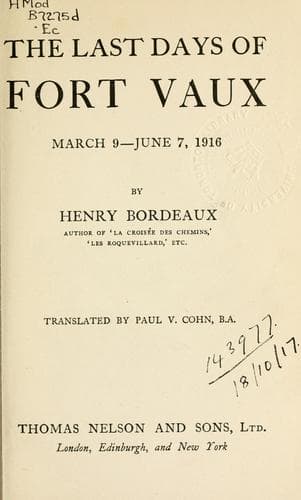
The Last Days of Fort Vaux, March 9-June 7, 1916 — John Shaqi
The Last Days of Fort Vaux, March 9-June 7, 1916Bordeaux, Henry
History
The Last Days of Fort Vaux, March 9-June 7, 1916
Bordeaux, Henry
Verdun, Battle of, Verdun, France, 1916; World War, 1914-1918 -- Personal narratives
With such questions as these he visited the observing stations, the
transverse galleries, the casemates, the turret, the armoury, the
provision stores, the cisterns, and inspected the garrison.
He had already come once before, at the beginning of August. This
second visit foreboded an early attack. The enemy was not far
off: he was known to be at Étain, at Billy-sous-Mangiennes, at
Romagne-sous-les-Côtes, not in great masses but in small detachments.
From the north, he was passing above Verdun and turning off to the
Argonne. Verdun, well defended, served the French Army as a pivotal
point for the immortal struggle of the Marne.
One of the neutral historians of the war, Gottlov Egelhaaf (quoted by
M. Hanotaux), has written: “If the Crown Princes of Bavaria and Prussia
had been in a position to seize Verdun in August-September 1914, and
accordingly to force the line of the Meuse, the German armies would
have burst upon Paris at one fell swoop. The two Princes, however, were
held up at Verdun, and thus the German supreme command was forced to
take the decision of leading back the right wing of their army. Verdun
could not be captured, and for this reason it seemed essential to
change the plan of campaign.” A very lame explanation of our victory
on the Marne, but one that at least emphasizes the importance of the
part played by Verdun in September 1914. Fate decreed that Verdun
should twice attract and twice wear out or shatter the German forces.
Only by hearing the roar of the guns could Fort Vaux follow the battle
fought on the left bank of the Meuse, before Rambercourt-aux-Pots,
Beauzée, La Vaux-Marie. From the roar of the guns it could convince
itself of the enemy’s retreat, of his withdrawal to the north.
Suddenly, however, on September 17, it hears the guns farther to the
south. The enemy hurls himself at Hattonchâtel and the Meuse Heights,
bombards the Roman camp above St. Mihiel, fights in the barracks of
Chauvoncourt. He has not yet abandoned the quarry that he covets. After
trying to invest Verdun on the left bank, he returns by way of the
right bank, but the front is fixed at Spada, Lamorville, and Combres.
It is fixed at three and a half to five miles in front of Fort Vaux on
the line Trésauvaux-Boinville-Fromezey-Ornes-Caures Wood. On February
18, 1915, a red-letter day, the fort is pounded with 420 mm. shells.
Douaumont has been favoured with some on the 15th and 17th, and it was
only right that Vaux should follow Douaumont. The fort examines its
wounds and is happy.
“The engineers have worked well. Only my superstructure has suffered.
My casemates are of good material.”
And it will rejoice exceedingly to learn next day that the range of
that famous 420 mm. battery has been found, that it has been shelled
in its turn and destroyed. The giants have been silenced, and that
promptly.
Public-domain text, read in full here on John Shaqi.
Reviews
Reviews
No reviews yet
Be the first to share your thoughts on this work.
Join the Discussion
Join the discussion
Sign in to leave a comment or review.
Sign InorCreate an account