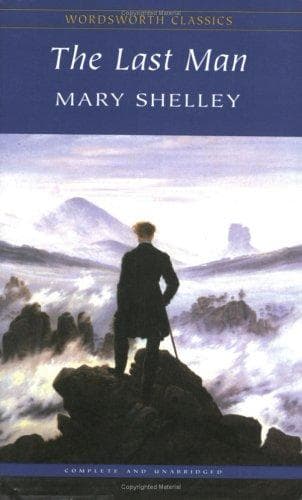
End of the world -- Fiction; Epidemics -- Fiction; Science fiction; Twenty-first century -- Fiction
I muttered to myself as I looked at the dark casements. At first I
thought I saw a light in one of them, but it proved to be merely the
refraction of the moon-beams, while the only sound was the crackling
branches as the breeze whirred the snow flakes from them—the moon
sailed high and unclouded in the interminable ether, while the shadow
of the cottage lay black on the garden behind. I entered this by the
open wicket, and anxiously examined each window. At length I detected a
ray of light struggling through a closed shutter in one of the upper
rooms—it was a novel feeling, alas! to look at any house and say there
dwells its usual inmate—the door of the house was merely on the latch:
so I entered and ascended the moon-lit staircase. The door of the
inhabited room was ajar: looking in, I saw Lucy sitting as at work at
the table on which the light stood; the implements of needlework were
about her, but her hand had fallen on her lap, and her eyes, fixed on
the ground, shewed by their vacancy that her thoughts wandered. Traces
of care and watching had diminished her former attractions—but her
simple dress and cap, her desponding attitude, and the single candle
that cast its light upon her, gave for a moment a picturesque grouping
to the whole. A fearful reality recalled me from the thought—a figure
lay stretched on the bed covered by a sheet—her mother was dead, and
Lucy, apart from all the world, deserted and alone, watched beside the
corpse during the weary night. I entered the room, and my unexpected
appearance at first drew a scream from the lone survivor of a dead
nation; but she recognised me, and recovered herself, with the quick
exercise of self-control habitual to her. “Did you not expect me?” I
asked, in that low voice which the presence of the dead makes us as it
were instinctively assume.
“You are very good,” replied she, “to have come yourself; I can never
thank you sufficiently; but it is too late.”
“Too late,” cried I, “what do you mean? It is not too late to take you
from this deserted place, and conduct you to—-”
My own loss, which I had forgotten as I spoke, now made me turn away,
while choking grief impeded my speech. I threw open the window, and
looked on the cold, waning, ghastly, misshaped circle on high, and the
chill white earth beneath—did the spirit of sweet Idris sail along the
moon-frozen crystal air?—No, no, a more genial atmosphere, a lovelier
habitation was surely hers!
Public-domain text, read in full here on John Shaqi.
Reviews
Reviews
No reviews yet
Be the first to share your thoughts on this work.
Elsewhere in the archive
Join the Discussion
Join the discussion
Sign in to leave a comment or review.
Sign InorCreate an account