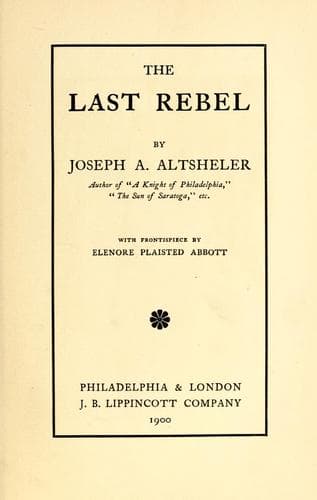
The Last RebelAltsheler, Joseph A. (Joseph Alexander)
History
The Last Rebel
Altsheler, Joseph A. (Joseph Alexander)
Prisoners -- Fiction; United States -- History -- Civil War, 1861-1865 -- Fiction
As his daughter and I talked more, the colonel talked less. Seen in
the light of the morning, his face looked rather worn, and once when
he threw his yet thick white hair back with his hand I noticed the
scar of a deep wound across his head. I began to feel sympathy for him
without knowing exactly why. He rose presently and excused himself,
saying it was time to give his men some directions for the day. Miss
Hetherill and I dawdled a little over the coffee-cups, and I took
the opportunity to thank her for her intercession with her father in
my favor. She did not make light of my thanks or of her act, and her
manner appeared to indicate a belief on her part that I had been in
real danger; which, however, I had not been able to persuade myself was
so, nor could I yet.
She asked me if I would look through the house,--I noticed she did not
call it fort, and I consented with gladness, saying I would be pleased
to go anywhere with so fair a guide, which she accepted with the
carelessness of one who had heard the like before.
She took me into a room she called the great parlor, and a noble room
it was, too, though here, as elsewhere, the atmosphere was distinctly
military. It was full thirty feet square, with a vaulted ceiling of
polished oak. Furs were on the floor and arms on the wall, repeating
rifles, revolvers, bayonets, swords in much variety.
"It is my father's chief delight to polish these and to see that they
are in perfect order," she said.
"Miss Hetherill," I said, speaking suddenly from impulse, "why does
your father cherish this delusion? Why does he not go and live among
his kind?"
I regretted instantly that I had spoken so, for she turned upon me with
a sudden flash of anger.
"Delusion, sir?" she exclaimed. "You forget yourself. It is the most
real thing in the world to him. Be careful how you make use of such
expressions here. I advise you also not to forget that you are still
my father's prisoner."
She spoke with so much earnestness that I was impressed, more from
fear that I had wounded her feelings than from fear for myself. I felt
confident yet that it was the year 1896; and that all the world was at
peace, barring the little wars of England, which don't count. She took
me no further than the great parlor--or the armory, if its fit name
be applied. My unfortunate question seemed to make some change in her
intentions, and she suggested that we walk outside on the terrace.
Public-domain text, read in full here on John Shaqi.
Reviews
Reviews
No reviews yet
Be the first to share your thoughts on this work.
Join the Discussion
Join the discussion
Sign in to leave a comment or review.
Sign InorCreate an account