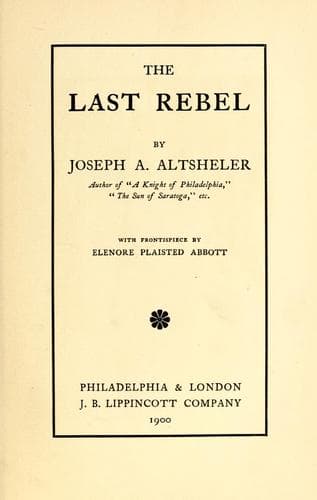
The Last RebelAltsheler, Joseph A. (Joseph Alexander)
History
The Last Rebel
Altsheler, Joseph A. (Joseph Alexander)
Prisoners -- Fiction; United States -- History -- Civil War, 1861-1865 -- Fiction
I think on the whole I am a tolerant man, but at this proposed
indignity my stomach revolted.
"I will not submit to a search," I said. "You have no right to do such
a thing."
"It is in perfect accordance with the laws of war," replied the
colonel, very calmly. "Spies are always searched. I do not see upon
what ground you base your protest."
He looked very determined, and I recalled the fact that I was opposed
to bruises and undignified struggles. Moreover, I remembered the
consoling fact that I had a refuge in injured innocence. When Crothers
went through my pockets I made no resistance. He found nothing more
dangerous than a penknife, a handkerchief, and some keys made to fit
doors very far from Fort Defiance.
"Are you satisfied?" I asked the colonel, when his man had finished.
"For the present," he replied, shortly. "I will have more to say to you
before long."
He and his men went out. They seemed to be very careful about fastening
the door, for they spent a deal of time fumbling with the lock.
I drew my stool up to the window and took my seat there, beginning my
second imprisonment in the same room; my second state, so the colonel
seemed to intend, was to be much worse than the first. The complex
character of this old warrior interested me and aroused my curiosity;
his fierce and somewhat stilted invective amused me, now that he had
gone from my presence, and I was in a state of wonder, too, as to what
the end of the adventure would be. A rare adventure it was, without
doubt, and I vowed to myself that it should not suffer in the telling
when I returned to my friends in the city.
Thus amused and surmising, all my vexation at the colonel's high-handed
treatment and verbal abuse of me departed. Instead, I wondered how any
man, at the end of thirty years, could cling so firmly and at such a
sacrifice to a lost and now vain cause. A feeling of hunger put a stop
to this guessing and wondering. The air of the morning had been crisp
and fresh, and I had worked hard over my unfortunate picture. I needed
refreshment, and, since I owed the colonel no politeness, I kicked
the door violently, in the hope that I would attract some one of his
Confederate veterans, to whom I could give my order.
Though I made a deal of noise, nobody responded, and I quit kicking.
I was tempted to smash the window, but rages are exhaustive and
ineffective, and I decided not to do so. At last I concluded to be a
martyr. It is one of the most consoling of all things to feel that you
are a martyr, and my peace of mind was restored. I decided that I would
not take the thing seriously, and that when I left Fort Defiance I
would not upbraid the colonel for his abuse of the laws of hospitality,
so sacred in the mountains.
Public-domain text, read in full here on John Shaqi.
Reviews
Reviews
No reviews yet
Be the first to share your thoughts on this work.
Join the Discussion
Join the discussion
Sign in to leave a comment or review.
Sign InorCreate an account