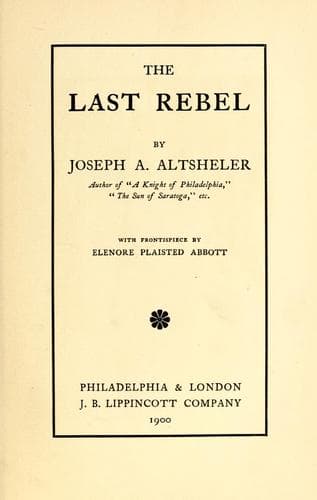
The Last RebelAltsheler, Joseph A. (Joseph Alexander)
History
The Last Rebel
Altsheler, Joseph A. (Joseph Alexander)
Prisoners -- Fiction; United States -- History -- Civil War, 1861-1865 -- Fiction
I resumed my seat by the window, and saw Grace Hetherill in the court.
She was looking up at my window, and when she saw my face there she
waved a handkerchief two or three times and then disappeared quickly
behind the wall. Now, let it be understood that I had no idea Grace
Hetherill was trying to flirt with me, but I was sure she had made
a signal of some kind. Perhaps she intended to encourage me, but I
fancied I scarcely needed that; not in the year of our Lord and deep
peace 1896.
I heard them fumbling at the door again. The colonel and two of his men
appeared.
"You will come with us, if you please," said the colonel, with the
stiff, military courtesy which he had never abated since his explosion
about the picture.
"I trust it is to dinner, colonel," I said, with some gayety, which I
really felt. "This mountain air of yours breeds hunger."
He made neither denial nor assent, but led the way down-stairs. The two
men followed close behind me, as if bent upon preserving the fiction
that I was a convict or criminal of some kind. Somewhat to my surprise,
the colonel led the way into the large room which Grace Hetherill
had called the great parlor. A new arrangement of its furniture had
been made. A long table with chairs around it had been placed in the
centre of the room, and drooping over it from the ceiling was a large
Confederate flag. Five or six men, including Dr. Ambrose, all dressed
in Confederate gray, were present.
The colonel saw my astonished and questioning look, and said,--
"I told you, Mr. West, that everything was to be done in accordance
with military law. The Confederacy would not disgrace itself by acting
otherwise. You are to have a fair trial."
All the men had risen to their feet and saluted the colonel. I was
invited to take a chair at the foot of the table; all the others took
their seats also. Dr. Ambrose again acted as secretary, the colonel
presiding, and the court-martial began.
I saw nothing better than to fall in with the spirit of the thing. Let
me repeat for the second time that I dislike bruises and undignified
struggles, and I had no choice. Accordingly, I pulled a very grave
and long face, and sat in silence, awaiting the questions that the
military tribunal might propound to me.
"I think," said the colonel, "it would be just to give the prisoner a
full and explicit statement of the charge against him."
"I think so, too," I said. "It would at least be interesting, if not
important."
The colonel frowned at my flippancy.
"You, sir," he said, addressing me, "who call yourself Arthur West, of
New York City, with what truth we know not, are accused of entering the
military lines of the Confederacy in civilian's attire for the purpose
of spying upon our fortifications, armaments, and other military
supplies, and of delivering such information as you might obtain to the
enemy. Is not that true, sir?"
"The war is over, colonel," I said. "The Confederacy perished more than
thirty years ago."
Public-domain text, read in full here on John Shaqi.
Reviews
Reviews
No reviews yet
Be the first to share your thoughts on this work.
Join the Discussion
Join the discussion
Sign in to leave a comment or review.
Sign InorCreate an account