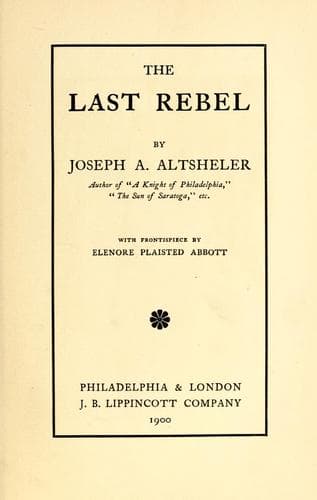
The Last RebelAltsheler, Joseph A. (Joseph Alexander)
History
The Last Rebel
Altsheler, Joseph A. (Joseph Alexander)
Prisoners -- Fiction; United States -- History -- Civil War, 1861-1865 -- Fiction
"You speak falsely, sir," he said, with some fierceness. "The war is
not over, and the Confederacy has not perished. See its flag over your
head. I hold my commission from President Jefferson Davis himself, and
certainly I have not laid down my arms."
I smiled a little, whistled a bar or two, and gazed at the ceiling. The
colonel looked deeply annoyed at my carelessness.
"Be careful, Mr. West," he said. "You are not helping your case by your
conduct."
"Colonel," I said, "come to see me in New York, and I'll show you the
town."
"Enough of such levity," he cried. "Will you or will you not plead to
the charge?"
"Colonel," I said, "it is the 18th of November, 1896, and a very fine
afternoon."
"I have warned you once already that you are prejudicing your own
case," he cried.
"I deny the jurisdiction of the tribunal," I said.
"Your denial goes for nothing," he said. "Do not enter it upon the
record, doctor. Will you say what brought you into these mountains?"
"As I have told you several times," I said, "I belong to a
hunting-party, and was lost. I did not know I was near Fort Defiance,
nor had I ever heard of such a place."
"Let that be entered upon the record, doctor," said the colonel.
"I have it all," said the doctor.
"Crothers," said the colonel, "put upon the table the sketch which I
found the prisoner making this morning."
Crothers obeyed.
"What do you call that?" said the colonel to me.
"I would call that," I replied, "a pretty bad picture of Fort Defiance."
My tone was light, and, as usual, my levity seemed to displease the
colonel very much. He warned me for the third time that I was injuring
my chances, but I was not impressed.
"That sketch," said he, "shows the situation and fortifications of Fort
Defiance. You were found drawing it surreptitiously. I ask you again,
what have you to say about it?"
"Nothing, colonel," I replied, "except that when we dine together in
New York we will discuss its artistic merits or lack of them."
The colonel ran his hand impatiently through his hair, and again
uncovered the scar of the deep wound on his head. I wondered in
what battle he had received it, and had a mind to ask him whenever
opportunity made the question pertinent.
"Make proper entries on the record," he said to the doctor, "that the
prisoner will give only irrelevant answers to our questions."
"It has been done," said the doctor.
The door of the room was opened at that moment, and Miss Hetherill
appeared. Her father rose hastily, and his manner showed that he was
disconcerted.
"You must retire at once, Grace," he said. "I forbade your presence
here."
"Father," she said, "you must stop these proceedings. You must not harm
Mr. West."
I rose and bowed in my best manner.
"I thank you for your intercession, Miss Hetherill," I said, "but I can
protect myself."
Public-domain text, read in full here on John Shaqi.
Reviews
Reviews
No reviews yet
Be the first to share your thoughts on this work.
Join the Discussion
Join the discussion
Sign in to leave a comment or review.
Sign InorCreate an account