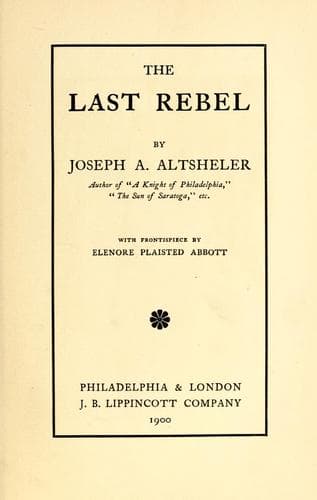
The Last RebelAltsheler, Joseph A. (Joseph Alexander)
History
The Last Rebel
Altsheler, Joseph A. (Joseph Alexander)
Prisoners -- Fiction; United States -- History -- Civil War, 1861-1865 -- Fiction
The sound of a trumpet, loud, clear, and penetrating, mingled with
the song of the winds, and swept through the mountains, echo after
echo. The military note rose above all the rest, and there by the
first light, which formed the background for it and made it visible,
I saw a human figure. I had no doubt that this was the man who blew
the trumpet, and it meant that the colonel and his men were seeking to
retake me. The trumpet was blown again, and all the lights except the
first were extinguished.
As I said, I am unable to analyze myself, and while a few moments ago
I wished to be back at Fort Defiance, I wished nothing of the kind now
that I knew the colonel and his men were seeking to take me there. I
pushed myself among some bushes, determined that I would escape.
With mountain heaped on mountain and the night helping, it would seem
that it was an easy enough matter for me to escape; but I was not so
sure. I had followed perforce some sort of path or trace, because it
was the only way in which I could go, and doubtless these men knew the
way well.
The trumpets blew one more blast, and from my covert I saw the last
light extinguished. Listening intently, I could hear only the sob of
the wind down the great slash in the mountains, at the bottom of which
I lay. I supposed that the flaming up of the lights and the blowing of
the trumpets had been some sort of signal to draw the men together.
I rose, but I could not see them either. I thought once of trying to
climb the side of the mountain, but I feared a stumble or a slip, the
noise of which would draw them to me. I pressed farther back into the
bushes, but just as I made myself snug several men turned the angle of
the ravine, and one of them held up a bright lantern. Its flame fell
directly upon me.
"Take aim," shouted the colonel.
The six who were with him covered me with their rifles. But I had no
desire to be shot.
"It's all right, colonel," I said. "I'll surrender. I'm your prisoner."
He ordered the men to lower their weapons. I walked out of the bushes
toward the colonel. There was some comfort in the company of my kind,
even if I was to be the prisoner and they the free men, an inequality
which I thought was not deserved.
"We retook you more easily than we thought," said the colonel.
"Then double my debt of gratitude to you, colonel," I said. "You may
have saved me again from death by starvation."
He said nothing to this, and I added, "Suppose we rest a little. I am
tired."
My bones in truth were weary; we were a long way from Fort Defiance,
and the road was rough. I contemplated the journey with dismay.
The colonel, who seemed to be highly pleased at my recapture, was in
good temper. He took a long flask from his inside pocket and shook it.
A cheerful gurgle came forth. He drew the cork with a loud plunk, and a
pleasant odor permeated the air.
"Try that," he said, holding out the flask.
Public-domain text, read in full here on John Shaqi.
Reviews
Reviews
No reviews yet
Be the first to share your thoughts on this work.
Join the Discussion
Join the discussion
Sign in to leave a comment or review.
Sign InorCreate an account