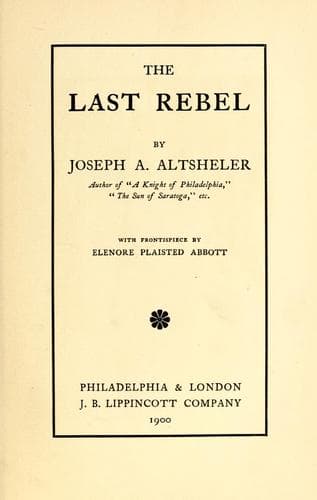
The Last RebelAltsheler, Joseph A. (Joseph Alexander)
History
The Last Rebel
Altsheler, Joseph A. (Joseph Alexander)
Prisoners -- Fiction; United States -- History -- Civil War, 1861-1865 -- Fiction
I tried it, and great was the result thereof. As the rich red liquor
trickled down my throat, I could feel strength flowing back into
muscle and bone, and a warm glow crept through all the veins of my
chilled body.
I handed the flask back to the colonel with my heart-felt thanks.
"I think I will try a little myself," he said, and the pleasant gurgle
was heard again.
"Colonel," I said, "you may shoot me to-morrow, but for heaven's sake
don't make me walk all the way back to Fort Defiance to-night."
The liquor had put him in a still better humor.
"I will not," he said. "Besides, I am tired myself."
He gave a few directions to his men, and they began to gather
brushwood, which was scattered about in abundance. They heaped it up in
a sheltered corner of the ravine, and the colonel, taking the candle
out of his lantern, touched the flame to the dry boughs. Up it blazed,
and, the wind catching it, the eager flame leaped from bough to bough.
The wood snapped and cracked as the fire seized it, and the blaze,
rising high, threw its warm and friendly light upon our faces.
Though a captive and with only twelve hours or so of life before me,
according to the colonel's limitations, I achieved comfort. I made
myself at home, and, pulling up a billet, sat down on it before the
fire, where body and eyes could feast on its warmth and light.
The fire by contrast made the darkness beyond its radius darker. The
colonel shivered, and then imitated my example, turning his palms to
the flames.
"Makes me think of the winter of '64," he said.
"Which was a long time ago," I replied.
"But it may come again," said he.
"Never," said I; "the cause is dead and buried, colonel, and the
mourners are few at this late day."
He turned his head away impatiently, as if he would not argue with a
prisoner. His men kept silent too. I had hoped they would hear, but I
could not say. They as well as I had brought food with them: we broke
bread and ate.
The fire, which rose yards high, and crackled as it ate into the wood,
threw streaks of light on the near slopes. Beyond, the darkness had
settled down over peak and ridge, and the moon was behind a veil of
clouds. The wind, rising again, moaned loudly down the ravine and swept
the dry leaves before it. I would not have escaped if I could.
"Winter will soon be here," said Crothers, who sat on one side of me.
"Perhaps it's as well," said Colonel Hetherill. "It will make it the
harder for any enemy to reach Fort Defiance."
A blast of wind struck me on the back of the neck and slipped down my
collar like a stream of ice-water. I edged up within scorching distance
of the fire.
"It is cold," said the colonel, replying to my thought as if I had
spoken aloud. He too edged up to the fire, and all his men did
likewise. No one regarded me with hostile eyes. For the moment the
military laws of the Confederacy rested lightly. I don't understand how
people can fight in the dark and when it's at zero.
Public-domain text, read in full here on John Shaqi.
Reviews
Reviews
No reviews yet
Be the first to share your thoughts on this work.
Join the Discussion
Join the discussion
Sign in to leave a comment or review.
Sign InorCreate an account