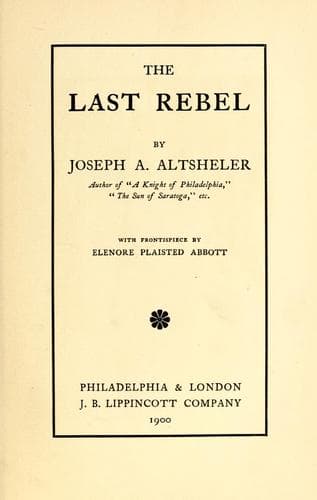
The Last RebelAltsheler, Joseph A. (Joseph Alexander)
History
The Last Rebel
Altsheler, Joseph A. (Joseph Alexander)
Prisoners -- Fiction; United States -- History -- Civil War, 1861-1865 -- Fiction
The doctor compelled to return, I took the flag and advanced with it.
But the colonel hated a Yankee spy as much as a traitor, and warned
me off in short order. We gave the flag to one of the soldiers, whom
the colonel allowed to approach a little closer. They held a brief
dialogue, and then our messenger came back to us, announcing that the
colonel regarded all his men as traitors or deserters and would parley
no further with them. They might besiege him if they would, but he
meant to make a last stand for the Confederacy.
"Was he well?" I asked the man.
"I didn't see him at all," he replied, "for he talked through a chink
in the wall, but his voice was mighty high and had a crack in it."
This confirmed me in my belief that privation and excitement had
mastered the colonel. Nevertheless we must sit down to a siege of
the last rebel. We arranged our forces in such manner that he could
not leave the hut and escape unseen into the further mountains. We
waited an hour; then, as the colonel in his castle made no sign, I
and a soldier went back for Grace. We found her in the hut, waiting
impatiently to hear from us, and she did not show much surprise when I
told her that her father had fortified himself against us.
She came at once with us, and we sent her to the colonel's castle. She
returned in a quarter of an hour much cast down, and told us he was in
a fever, with wild eyes and flushed face. He refused to come out, and
nothing she said could move him. He even spoke harsh words to her,
saying she had joined his enemies. We sent her back with a couple of
blankets and some provisions, and then she returned to us again. The
colonel would allow no second person in his defensive works.
It looked like a long siege, and we prepared for it. We soon found
Crothers and his party, and we built another shack in the woods,
bringing from it the furs and other useful articles in the hut. It
was well that we did the work quickly, for Grace fell quite ill with
hardships and excitement, and soon was in a fever and talking a bit
wildly.
We put her in the shack on a bed of furs, and Dr. Ambrose, who did not
have the title of doctor in vain, attended her, and said she would be
all right in a day or so. But her illness was a misfortune, for she was
the only one who could be considered a strict neutral and could carry
messages between our little army and the colonel.
We were sufficient in number to form a picket around Fort Hetherill,
for so I named the colonel's shack, but we were very careful not to
come within range of its defender's rifle. One of the men, a good
fellow named Kimball, went a little closer than the rest of us, and
the prompt discharge of the rifle from Fort Hetherill showed that the
colonel was watching. The bullet skipped across the ice fifty feet
short of its mark. Kimball moved farther away.
Public-domain text, read in full here on John Shaqi.
Reviews
Reviews
No reviews yet
Be the first to share your thoughts on this work.
Join the Discussion
Join the discussion
Sign in to leave a comment or review.
Sign InorCreate an account