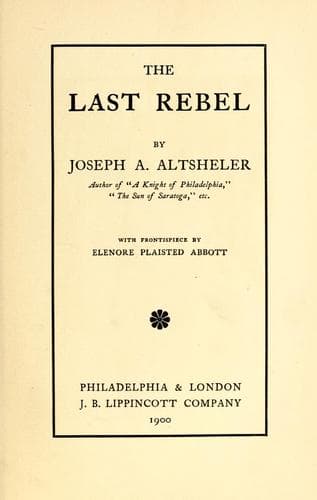
The Last RebelAltsheler, Joseph A. (Joseph Alexander)
History
The Last Rebel
Altsheler, Joseph A. (Joseph Alexander)
Prisoners -- Fiction; United States -- History -- Civil War, 1861-1865 -- Fiction
Having posted the men, I made a round and cautioned each to watch
faithfully. But the caution was scarcely necessary. Every man there was
under heavy obligations to the colonel for something or other, and all
meant to take him alive.
It was cold work there on the ice, but we had brought provisions with
us, and that supply, coupled with what was stored in the hut, prepared
us amply for a siege in form. We made some coffee and served it to
the men on picket duty, following it up a little later with a nip
of whiskey for each, and they felt quite warm and comfortable. The
colonel, after his rifle-shot, rested on his arms and maybe looked to
his defences. The piece of old stove-pipe which projected through the
roof began to smoke, showing that he had firewood and that he too was
able to keep warm. It looked like a long siege.
The general commanding, who was myself, and Crothers, the second in
command, held a council of war and decided to postpone operations until
nightfall, when Crothers thought he would be able under cover of the
darkness to steal upon the colonel and take him. Then we waited for the
slow afternoon to limp away. The sun was of a dazzling brightness, but
there was no warmth in it. The ice-fields glittered under the rays,
but did not melt. The light was reflected, and with half-shut eyes we
watched the peaks and the coated trees. Sometimes faint blue, purple,
and green tints showed through the white glare.
"Crothers," said I, "if ever I go on another winter campaign like this,
I will not forget a pair of green goggles, largest size."
"I wish I had them now," said Crothers.
The glow on the ice-fields turned to gold as the sun began to set
behind the highest peak, from gold shifted to a blood-red, and as the
sun went out of sight faded and left the pale green of a wan twilight.
"These sheets of ice are in our way in more ways than one," said
Crothers. "They light up the night so much that I could put a bullet in
a silver quarter at twenty paces."
"Do you think the colonel could do as well?" I asked, somewhat
anxiously.
We thought it well to wait until past midnight, when the night would
be darkest. So we served supper and hot coffee, relieved the pickets,
and waited. The colonel in his fortress seemed to be content: at least
he gave no sign. Dr. Ambrose reported that Miss Hetherill was much
better and would be on her feet again in the morning. The night limped
as painfully as the day, and had the added demerit of being colder.
A wind came down from the northeast, and there was a raw sharp edge to
it. I shivered and my bones creaked with cold inside the heavy overcoat
Crothers had given me. May the good Lord deliver me from any more
winter campaigns! The moon, pale and icy, rose, and its chilly rays
were reflected from the more chilly ice. Pieces of ice blown from the
crusted boughs rattled dryly as they fell.
Public-domain text, read in full here on John Shaqi.
Reviews
Reviews
No reviews yet
Be the first to share your thoughts on this work.
Join the Discussion
Join the discussion
Sign in to leave a comment or review.
Sign InorCreate an account