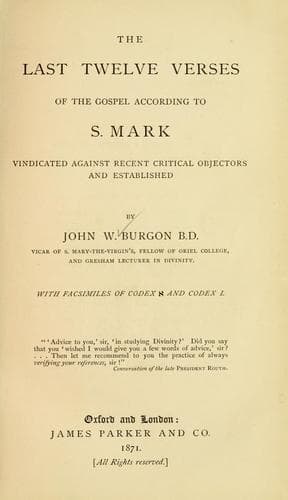
The Last Twelve Verses of the Gospel According to S. MarkBurgon, John William
Religion
The Last Twelve Verses of the Gospel According to S. Mark
Burgon, John William
Bible. Mark XVI, 9-20 -- Criticism, Textual
The first difficulty of this class is very fairly stated by one whose name
I cannot write without a pang,—the late Dean Alford:—
(I.) The expression πρώτη σαββάτου, for the “first day of the week” (in
ver. 9) “is remarkable” (he says) “as occurring so soon after” μία
σαββάτων (a precisely equivalent expression) in ver. 2.—Yes, it is
remarkable.
Scarcely more remarkable, perhaps, than that S. Luke _in the course of one
and the same chapter_ should four times designate the Sabbath τὸ σάββατον,
and twice τὰ σάββατα: again, twice, τὸ σάββατον,—twice, ἡ ἡμέρα τοῦ
σαββάτου,—and once, τὰ σάββατα.(255) Or again, that S. Matthew should _in
one and the same chapter_ five times call the Sabbath, τὰ σάβββτα, and
three times, τό σάββατον.(256) Attentive readers will have observed that
the Evangelists seem to have been fond in this way of varying their
phrase; suddenly introducing a new expression for something which they had
designated differently just before. Often, I doubt not, this is done with
the profoundest purpose, and sometimes even with manifest design; but the
phenomenon, however we may explain it, still remains. Thus, S. Matthew,
(in his account of our LORD’S Temptation,—chap. iv.,) has ὁ διάβολος in
ver. 1, and ὁ πειράζων in ver. 3, for him whom our SAVIOUR calls Σατανᾶς
in ver. 10.—S. Mark, in chap. v. 2, has τὰ μνημεῖα,—but in ver. 5, τὰ
μνήματα.—S. Luke, in xxiv. 1, has τὸ μνῆμα; but in the next verse, τὸ
μνημεῗον.—Ἐπί with an accusative twice in S. Matth. xxv. 21, 23, is twice
exchanged for ἐπί with a genitive in the same two verses: and ἔριφοϋ (in
ver. 32) is exchanged for ἐρίφια in ver. 33.—Instead of ἄρχων τς συναγωγῆς
(in S. Luke viii. 41) we read, in ver. 49, ἀρχισυνάγωγος: and for οἱ
ἀπόστολοι (in ix. 10) we find οἱ δώδεκα in ver. 12.—Οὖς in S. Luke xxii.
50 is exchanged for ὠτίον in the next verse.—In like manner, those whom S.
Luke calls οἱ νεώτεροι in Acts v. 6, he calls νεανίσκοι in ver. 10.... All
such matters strike me as highly interesting, but not in the least as
suspicious. It surprises me a little, of course, that S. Mark should
present me with πρώτη σαββάτου (in ver. 9) instead of the phrase μία
σαββάτων, which he had employed just above (in ver. 2.) But it does not
surprise me much,—when I observe that μία σαββάτων _occurs only once in
each of the Four Gospels_.(257) Whether surprised much or little,
however,—Am I constrained in consequence, (with Tischendorf and the rest,)
to regard this expression (πρώτη σαββάτου) as a note of _spuriousness_?
That is the only thing I have to consider. Am I, with Dr. Davidson, to
reason as follows:—“πρώτη, Mark would scarcely have used. It should have
been μία, &c. as is proved by Mark xvi. 2, &c. The expression could
scarcely have proceeded from a Jew. It betrays a Gentile author.”(258) Am
I to reason thus?... I propose to answer this question somewhat in detail.
Public-domain text, read in full here on John Shaqi.
Reviews
Reviews
No reviews yet
Be the first to share your thoughts on this work.
Elsewhere in the archive
Join the Discussion
Join the discussion
Sign in to leave a comment or review.
Sign InorCreate an account