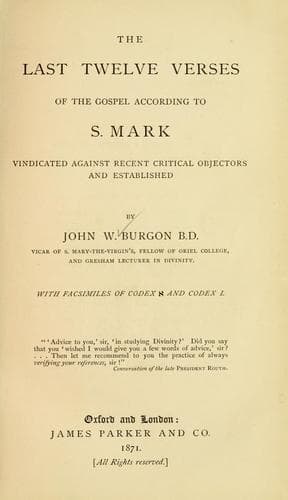
The Last Twelve Verses of the Gospel According to S. MarkBurgon, John William
Religion
The Last Twelve Verses of the Gospel According to S. Mark
Burgon, John William
Bible. Mark XVI, 9-20 -- Criticism, Textual
(1.) That among the Greek-speaking Jews of Palestine, in the days of the
Gospel, ἡ μία τῶν σαββάτων was the established method of indicating “the
first day of the week,” is plain, not only from the fact that the day of
the Resurrection is so designated by each of the Four Evangelists in
turn;(259) (S. John has the expression twice;) but also from S. Paul’s use
of the phrase in 1 Cor. xvi. 2. It proves, indeed, to have been the
ordinary Hellenistic way of exhibiting the vernacular idiom of
Palestine.(260) The cardinal (μία) for the ordinal (πρώτη) in this phrase
was a known Talmudic expression, which obtained also in Syriac.(261)
Σάββατον and σάββατα,—designations in strictness of the _Sabbath-day_,—had
come to be _also_ used as designations of the _week_. A reference to S.
Mark xvi. 9 and S. Luke xviii. 12 establishes this concerning σάββατον: a
reference to the six places cited just now in earlier note establishes it
concerning σαββάτα. To see how indifferently the two forms (σάββατον and
σαββάτα) were employed, one has but to notice that S. Matthew, _in the
course of one and the same chapter_, five times designates the Sabbath as
τὰ σαββάτα, and three times as τὸ σάββατον.(262) The origin and history of
both words will be found explained in a note at the foot of the page.(263)
(2.) Confessedly, then, a double Hebraism is before us, which must have
been simply unintelligible to Gentile readers. Μία τῶν σαββάτων sounded as
enigmatical to an ordinary Greek ear, as “_una sabbatorum_” to a Roman. A
convincing proof, (if proof were needed,) how abhorrent to a Latin reader
was the last-named expression, is afforded by the old Latin versions of S.
Matthew xxviii. 1; where ὄψε σαββάτων, τῇ ἐπιφωσκούση εἰς μίαν σαββάτων is
invariably rendered, “Vespere _sabbati_, quæ lucescit in _prima sabbati_.”
(3.) The reader will now be prepared for the suggestion, that when S.
Mark, (who is traditionally related to have written his Gospel _at
Rome_,(264)) varies, in ver. 9, the phrase he had employed in ver. 2, he
does so for an excellent and indeed for an obvious reason. In ver. 2, he
had conformed to the prevailing usage of Palestine, and followed the
example set him by S. Matthew (xxviii. 1) in adopting the enigmatical
expression, ἡ μία σαββάτων. That this would be idiomatically represented
_in Latin_ by the phrase “prima sabbati,” we have already seen. In ver. 9,
therefore, he is solicitous to record the fact of the Resurrection afresh;
and _this_ time, his phrase is observed to be _the Greek equivalent for
the Latin _“prima sabbati;” viz. πρώτη σαββάτου. How strictly equivalent
the two modes of expression were felt to be by those who were best
qualified to judge, is singularly illustrated by the fact that the
_Syriac_ rendering of both places is _identical_.
Public-domain text, read in full here on John Shaqi.
Reviews
Reviews
No reviews yet
Be the first to share your thoughts on this work.
Elsewhere in the archive
Join the Discussion
Join the discussion
Sign in to leave a comment or review.
Sign InorCreate an account