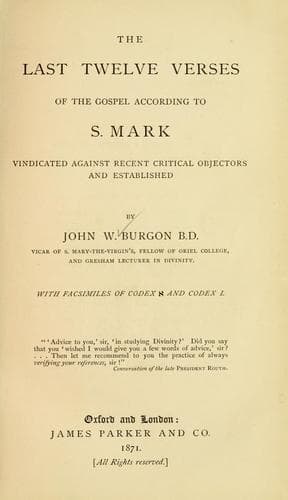
The Last Twelve Verses of the Gospel According to S. MarkBurgon, John William
Religion
The Last Twelve Verses of the Gospel According to S. Mark
Burgon, John William
Bible. Mark XVI, 9-20 -- Criticism, Textual
(4.) But I take leave to point out that this substituted phrase, instead
of being a suspicious circumstance, is on the contrary a striking note of
genuineness. For do we not recognise here, in the last chapter of the
Gospel, the very same hand which, in the first chapter of it, was careful
to inform us, just for once, that “Judæa,” is “a _country_,” (ἡ Ἰουδαία
χώρα,)—and “Jordan,” “a _river_,” (ὁ Ἰορδάνης ποταμός)?—Is not this the
very man who explained to his readers (in chap. xv. 42) that the familiar
Jewish designation for “Friday,” ἡ παρασκευή, denotes “_the day before the
Sabbath_?”(265)—and who was so minute in informing us (in chap. vii. 3, 4)
about certain ceremonial practices of “the Pharisees and all the Jews?”
Yet more,—Is not the self-same writer clearly recognisable in this xvith
chapter, who in chap. vi. 37 presented us with σπεκουλάτωρ (the Latin
_spiculator_) for “an executioner?” and who, in chap. xv. 39, for “a
_centurion_,” wrote—not ἑκατόνταρχος, but—κεντυρίων?—and, in chap. xii.
42, explained that the two λεπτά which the poor widow cast into the
Treasury were equivalent to κοδράντης, the Latin _quadrans_?—and in chap.
vii. 4, 8, introduced the Roman measure _sextarius_, (ξέστης)?—and who
volunteered the information (in chap. xv. 16) that αὐλή is only another
designation of πραιτώριον (_Prætorium_)?—Yes. S. Mark,—who, alone of the
four Evangelists, (in chap. xv. 21,) records the fact that Simon the
Cyrenian was “_the father of Alexander and Rufus_,” evidently for the sake
of his _Latin_ readers:(266) S. Mark,—who alone ventures to write in Greek
letters (οὐά,—chap. xv. 29,) the Latin interjection “_Vah!_”—obviously
because he was writing where that exclamation was most familiar, and the
force of it best understood:(267) S. Mark,—who attends to the Roman
division of the day, in relating our LORD’S prophecy to S. Peter:(268)—S.
Mark, I say, no doubt it was who,—having conformed himself to the
precedent set him by S. Matthew and the familiar usage of Palestine; and
having written τῆς μιᾶς σαββάτων, (which he knew would sound like “_una
sabbatorum_,”(269)) in ver. 2;—introduced, also for the benefit of his
Latin readers, the Greek equivalent for “_prima sabbati_,” (viz. πρώτη
σαββάτου,) in ver. 9.—This, therefore, I repeat, so far from being a
circumstance “_unfavourable_ to its authenticity,” (by which, I presume,
the learned writer means its _genuineness_), is rather corroborative of
the Church’s constant belief that the present section of S. Mark’s Gospel
is, equally with the rest of it, the production of S. Mark. “Not only was
the document intended for Gentile converts:” (remarks Dr. Davidson, p.
149,) “but there are also appearances of its adaptation to the use of
Roman Christians in particular.” Just so. And I venture to say that in the
whole of “the document” Dr. Davidson will not find a more striking
“appearance of its adaptation to the use of Roman Christians,”—_and
therefore of its genuineness_,—than this.
Public-domain text, read in full here on John Shaqi.
Reviews
Reviews
No reviews yet
Be the first to share your thoughts on this work.
Elsewhere in the archive
Join the Discussion
Join the discussion
Sign in to leave a comment or review.
Sign InorCreate an account