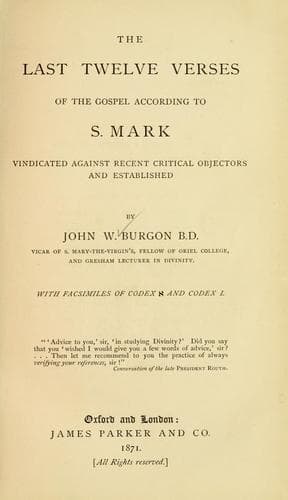
The Last Twelve Verses of the Gospel According to S. MarkBurgon, John William
Religion
The Last Twelve Verses of the Gospel According to S. Mark
Burgon, John William
Bible. Mark XVI, 9-20 -- Criticism, Textual
I shall have to request my
reader by-and-by to accept it as one of the most striking notes of Divine
origin which these verses contain.—For the moment, I pass on.
(II.) Less excusable is the coarseness of critical perception betrayed by
the next remark. It has been pointed out as a suspicious circumstance that
in ver. 9, “the phrase ἀφ᾽ ἧς ἐκβεβλήκει ἑπτα δαιμόνια is attached to the
name of Mary Magdalene, although she had been mentioned three times before
without such appendix. It seems to have been taken from Luke viii.
2.”(270)—Strange perversity, and yet stranger blindness!
(1.) The phrase _cannot_ have been taken from S. Luke; because S. Luke’s
Gospel was written after S. Mark’s. It _was_ not taken from S. Luke;
because _there_ ἀφ᾽ ἧς δαιμόνια ἑπτα ἐξεληλύθει,—here, ἀφ᾽ ἧς ἐκβεβλήκει
ἑπτα δαιμόνια is read.
(2.) More important is it to expose the shallowness and futility of the
entire objection.—Mary Magdalene “had been mentioned three times before,
_without such appendix_.” Well but,—What _then_? After twice (ch. xiv. 54,
66) using the word αὐλή without any “appendix,” in the very next chapter
(xv. 16) S. Mark adds, ὅ ἐστι πραιτώριον.—The beloved Disciple having
mentioned himself without any “appendix” in S. John xx. 7, mentions
himself with a very elaborate “appendix” in ver. 20. But what of it?—The
sister of the Blessed Virgin, having been designated in chap. xv. 40, as
Μαρία ἡ Ἰακώβου τοῦ μικροῦ καὶ Ἰωσῆ μήτηρ; is mentioned with one half of
that “appendix,” (Μαρία ἡ Ἰωσῆ) in ver. 47, and _in the very next verse_,
with the other half (Μαρία ἡ τοῦ Ἰακώβου.)—I see no reason why the
Traitor, who, in S. Luke vi. 16, is called Ἰούδας Ἰσκαριώτης, should be
designated as Ἰούδαν τὸν ἐπικαλούμενον Ἰσκαριώτην in S. Luke xxii. 3.—I am
not saying that such “appendices” are either uninteresting or unimportant.
That I attend to them habitually, these pages will best evince. I am only
insisting that to infer from such varieties of expression that a different
author is recognisable, is abhorrent to the spirit of intelligent
Criticism.
(3.) But in the case before us, the hostile suggestion is peculiarly
infelicitous. There is even inexpressible tenderness and beauty, the
deepest Gospel significancy, in the reservation of the clause “out of whom
He had cast seven devils,” for this place. The reason, I say, is even
obvious why an “appendix,” which would have been meaningless before, is
introduced in connexion with Mary Magdalene’s august privilege of being
the first of the human race to behold the risen SAVIOUR. Jerome (I rejoice
to find) has been beforehand with me in suggesting that it was done, in
order to convey by an example the tacit assurance that “where Sin had
abounded, there did Grace much more abound.”(271) Are we to be cheated of
our birthright by Critics(272) who, entirely overlooking a solution of the
difficulty (_if_ difficulty it be) Divine as this, can see in the
circumstance grounds only for suspicion and cavil? Απαγε.
Public-domain text, read in full here on John Shaqi.
Reviews
Reviews
No reviews yet
Be the first to share your thoughts on this work.
Elsewhere in the archive
Join the Discussion
Join the discussion
Sign in to leave a comment or review.
Sign InorCreate an account