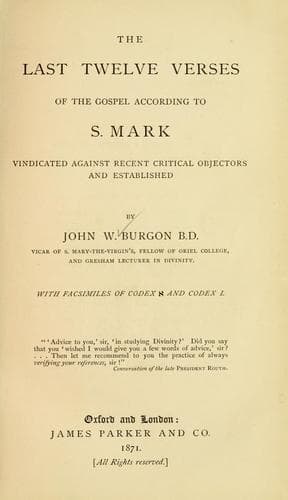
The Last Twelve Verses of the Gospel According to S. MarkBurgon, John William
Religion
The Last Twelve Verses of the Gospel According to S. Mark
Burgon, John William
Bible. Mark XVI, 9-20 -- Criticism, Textual
(III.) Take the next example.—The very form of the “appendix” which we
have been considering (ἀφ᾽ ἦς ἐκβεβλήκει ἑπτὰ δαιμόνια) breeds offence.
“Instead of ἐκβάλλειν ἀπό,” (oracularly remarks Dr. Davidson,) “Mark has
ἐκβάλλειν ἐκ.”(273)
Nothing of the sort, I answer. S. Mark _once_ has ἐκβάλλειν ἐκ,(274) and
_once_ ἐκβάλλειν ἀπό. So has S. Matthew, (viz. in chap. vii. 4 and 5): and
so has S. Luke, (viz. in chap. vi. 42, and in Acts xiii. 50.)—But what of
all this? _Who_ sees not that such Criticism is simply nugatory?
(IV.) We are next favoured with the notable piece of information that the
word πορεύεσθαι, “never used by S. Mark, is three times contained in this
passage;” (viz. in verses 10, 12 and 15.)
(1.) Yes. The uncompounded verb, never used _elsewhere_ by S. Mark, is
found here three times. But what then? The _compounds_ of πορεύεσθαι are
common enough in his Gospel. Thus, short as his Gospel is, he alone has
εἰσ-πορεύεσθαι, ἐκ-πορεύεσθαι, συμ-πορεύεσθαι, παρα-πορεύεσθαι, _oftener
than all the other three Evangelists put together_,—viz. twenty-four times
against their nineteen: while the compound προσπορεύεσθαι is _peculiar to
his Gospel_.—I am therefore inclined to suggest that the presence of the
verb πορεύεσθαι in these Twelve suspected Verses, instead of being an
additional element of suspicion, is rather a circumstance slightly
corroborative of their genuineness.
(2.) But suppose that the facts had been different. The phenomenon
appealed to is of even perpetual recurrence, and may on no account be
represented as _suspicious_. Thus, παρουσία, a word used only by S.
Matthew among the Evangelists, is by him used four times; yet are all
those four instances found _in one and the same chapter_. S. Luke alone
has χαρίζεσθαι, and he has it three times: but all three cases are met
with _in one and the same chapter_. S. John alone has λύπη, and he has it
four times: but all the four instances occur _in one and the same
chapter_.
(3.) Such instances might be multiplied to almost any extent. Out of the
fifteen occasions when S. Matthew uses the word τάλαντον, no less than
fourteen occur in one chapter. The nine occasions when S. Luke uses the
word μνᾶ all occur in one chapter. S. John uses the verb ἀνιστάναι
transitively only four times: but all four instances of it are found in
one chapter.—Now, these three words (be it observed) are _peculiar to the
Gospels_ in which they severally occur.
(4.) I shall of course be reminded that τάλαντον and μνᾶ are unusual
words,—admitting of no substitute in the places where they respectively
occur. But I reply,—Unless the Critics are able to shew me _which_ of the
ordinary compounds of πορεύεσθαι S. Mark could _possibly_ have employed
for the uncompounded verb, in the three places which have suggested the
present inquiry, viz.:—
ver. 10:—ἐκείνη πορευθεῖσα ἀπήγγειλε τοῖς μετ᾽ αυτοῦ γενομένοις.
ver. 12:—δυσὶν ἐξ αὐτῶν ... πορευομένοις εἰς ἀγρόν.
Public-domain text, read in full here on John Shaqi.
Reviews
Reviews
No reviews yet
Be the first to share your thoughts on this work.
Elsewhere in the archive
Join the Discussion
Join the discussion
Sign in to leave a comment or review.
Sign InorCreate an account