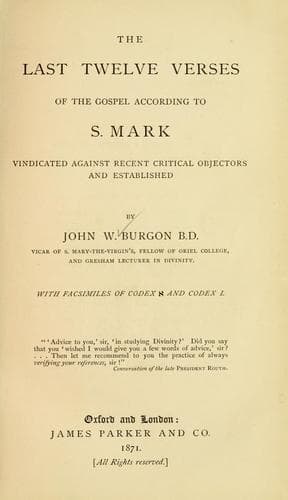
The Last Twelve Verses of the Gospel According to S. MarkBurgon, John William
Religion
The Last Twelve Verses of the Gospel According to S. Mark
Burgon, John William
Bible. Mark XVI, 9-20 -- Criticism, Textual
ver. 13:—πορευθέντες εἰς τὸν κόσμον ἄπαντα, κηρύξατε τὸ εὐαγγέλιον;—
their objection is simply frivolous, and the proposed adverse reasoning,
worthless. Such, in fact, it most certainly is; for it will be found that
πορευθεῖσα in ver. 10,—πορευομένοις in ver. 12,—πορευθέντες in ver.
15,—_also_ “admit of no substitute in the places where they severally
occur;” and therefore, since the verb itself is one of S. Mark’s favourite
verbs, not only are these three places above suspicion, but they may be
fairly adduced as indications that _the same_ hand was at work here which
wrote all the rest of his Gospel.(275)
(V.) Then further,—the phrase τοῖς μετ᾽ αὐτοῦ γενομένοις (in ver. 10) is
noted as suspicious. “Though found in the Acts (xx. 18) it _never occurs
in the Gospels_: nor does the word μαθηταί in this passage.”
(1.) The phrase οἱ μετ᾽ αὐτοῦ γενόμενοι occurs nowhere in the Acts or in
the Gospels, _except here_. But,—Why _should_ it appear elsewhere? or
rather,—How _could_ it? Now, if the expression be (as it is) an ordinary,
easy, and obvious one,—_wanted_ in this place, where it _is_ met with; but
_not_ met with elsewhere, simply because elsewhere it is _not_
wanted;—surely it is unworthy of any one calling himself a Critic to
pretend that there attaches to it the faintest shadow of suspicion!
(2.) The essence of the phrase is clearly the expression οἱ μετ᾽ αυτοῦ.
(The aorist participle of γίνομαι, is added of necessity to mark the
persons spoken of. In no other, (certainly in no simpler, more obvious, or
more precise) way could the followers of the risen SAVIOUR have been
designated at such a time. For had He not just now “overcome the sharpness
of Death”?) But this expression, which occurs four times in S. Matthew and
four times in S. Luke, occurs also four times in S. Mark: viz. in chap. i.
36; ii. 25; v. 40, _and here_. This, therefore, is a slightly
corroborative circumstance,—not at all a ground of suspicion.
(3.) But it seems to be implied that S. Mark, because he mentions τοὺς
μαθητάς often elsewhere in his Gospel, ought to have mentioned them here.
(a) I answer:—He does not mention τοὺς μαθητάς nearly so often as S.
Matthew; while S. John notices them twice as often as he does.
(b) Suppose, however, that he elsewhere mentioned them five hundred times,
because he had occasion five hundred times to speak of them;—what reason
would _that_ be for his mentioning them here, where he is _not_ speaking
of them?
Public-domain text, read in full here on John Shaqi.
Reviews
Reviews
No reviews yet
Be the first to share your thoughts on this work.
Elsewhere in the archive
Join the Discussion
Join the discussion
Sign in to leave a comment or review.
Sign InorCreate an account