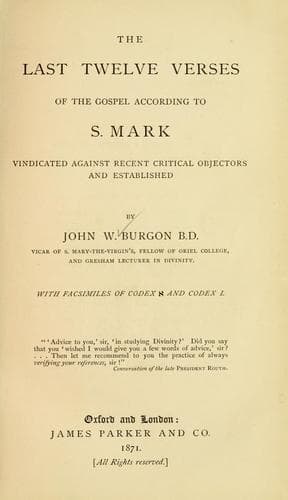
The Last Twelve Verses of the Gospel According to S. MarkBurgon, John William
Religion
The Last Twelve Verses of the Gospel According to S. Mark
Burgon, John William
Bible. Mark XVI, 9-20 -- Criticism, Textual
(_c_) It must be evident to any one reading the Gospel with attention that
besides οἱ μαθηταί,—(by which expression S. Mark always designates _the
Twelve Apostles_,)—there was a considerable company of believers assembled
together throughout the first Easter Day.(276) S. Luke notices this
circumstance when he relates how the Women, on their return from the
Sepulchre, “told all these things unto the Eleven, and _to all the rest_,”
(xxiv. 9): and again when he describes how Cleopas and his companion (δύο
ἐξ αὐτῶν as S. Luke and S. Mark call them) on their return to Jerusalem,
“found the Eleven gathered together, _and them that were with them_”
(xxiv. 33.) But this was at least as well known to S. Mark as it was to S.
Luke. Instead, therefore, of regarding the designation “_them that had
been with Him_” with suspicion,—are we not rather to recognise in it one
token more that the narrative in which it occurs is unmistakably genuine?
What else is this but one of those delicate discriminating touches which
indicate the hand of a great Master; one of those evidences of minute
accuracy which stamp on a narrative the impress of unquestionable Truth?
(VI.) We are next assured by our Critic that θεᾶσθαι “is unknown to Mark;”
but it occurs twice in this section, (viz. in ver. 11 and ver. 14.)
_Another_ suspicious circumstance!
(1.) A strange way (as before) of stating an ordinary fact, certainly!
What else is it but to assume the thing which has to be proved? If the
learned writer had said instead, that the verb θεᾶσθαι, here twice
employed by S. Mark, occurs _nowhere else_ in his Gospel,—he would have
acted more loyally, not to say more fairly by the record: but then he
would have been stating a strictly ordinary phenomenon,—of no
significancy, or relevancy to the matter in hand. He is probably aware
that παραβαίνειν in like manner is to be found in two consecutive verses
of S. Matthew’s Gospel; παρακούειν, twice in the course of one verse:
neither word being used on any other occasion _either by S. Matthew, or by
any other Evangelist_. The same thing precisely is to be said of ἀναζητεῖν
and ἀνταποδιδόναι, of ἀντιπαρέρχεσθαι, and διατίθεσθαι, in S. Luke: of
ἀνιστάναι and ζωννύναι in S. John. But who ever dreamed of insinuating
that the circumstance is suspicious?
(2.) As for θεᾶσθαι, we should have reminded our Critic that this verb,
which is used seven times by S. John, and four times by S. Matthew, is
used only three times by S. Luke, and only twice by S. Mark. And we should
have respectfully inquired,—What possible suspicion does θεᾶσθαι throw
upon the last twelve verses of S. Mark’s Gospel?
Public-domain text, read in full here on John Shaqi.
Reviews
Reviews
No reviews yet
Be the first to share your thoughts on this work.
Elsewhere in the archive
Join the Discussion
Join the discussion
Sign in to leave a comment or review.
Sign InorCreate an account