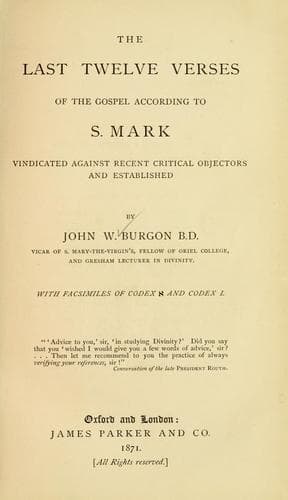
The Last Twelve Verses of the Gospel According to S. MarkBurgon, John William
Religion
The Last Twelve Verses of the Gospel According to S. Mark
Burgon, John William
Bible. Mark XVI, 9-20 -- Criticism, Textual
(3.) None whatever, would have been the reply. But in the meantime Dr.
Davidson hints that the verb _ought_ to have been employed by S. Mark in
chap. ii. 14.(277)—It is, I presume, sufficient to point out that S.
Matthew, at all events, was not of Dr. Davidson’s opinion:(278) and I
respectfully submit that the Evangelist, inasmuch as he happens to be here
_writing about himself_, must be allowed, just for once, to be the better
judge.
(4.) In the meantime,—Is it not perceived that θεᾶσθαι is the very word
specially required in these two places,—though _nowhere else in S. Mark’s
Gospel_?(279) The occasion is one,—viz. the “beholding” of the person of
the risen SAVIOUR. Does not even natural piety suggest that the uniqueness
of such a “spectacle” as _that_ might well set an Evangelist on casting
about for a word of somewhat less ordinary occurrence? The occasion cries
aloud for this very verb θεᾶσθαι; and I can hardly conceive a more apt
illustration of a darkened eye,—a spiritual faculty perverted from its
lawful purpose,—than that which only discovers “a stumbling-block and
occasion of falling” in expressions like the present which “should have
been only for their wealth,” being so manifestly designed for their
edification.
(VII.) But,—(it is urged by a Critic of a very different stamp,)—ἐθεάθη
ὑπ᾽ αὐτῆς (ver. 11) “is a construction only found here in the New
Testament.”
(1.) Very likely; but what then? The learned writer has evidently
overlooked the fact that the passive θεᾶσθαι occurs but _three times_ in
the New Testament _in all_.(280) S. Matthew, on the _two_ occasions when
he employs the word, connects it with a dative.(281) What is there
_suspicious_ in the circumstance that θεᾶσθαι ὑπό should be the
construction preferred by S. Mark? The phenomenon is not nearly so
remarkable as that S. Luke, on one solitary occasion, exhibits the phrase
μὴ φοβεῖσθε ἀπό,(282)—instead of making the verb govern the accusative, as
he does three times _in the very next verse_; and, indeed, eleven times in
the course of his Gospel. To be sure, S. Luke in this instance is but
copying S. Matthew, who _also_ has μὴ φοβεῖσθε ἀπό once;(283) and seven
times makes the verb govern an accusative. This, nevertheless, constitutes
no reason whatever for suspecting the genuineness either of S. Matth. x.
28 or of S. Luke xii. 4.
(2.) In like manner, the phrase ἐφοβήθησαν φόβον μέγαν will be found to
occur once, and once _only_, in S. Mark,—once, and once only, in S.
Luke;(284) although S. Mark and S. Luke use the verb φοβεῖσθαι upwards of
forty times. Such facts are interesting. They may prove important. But no
one who is ever so little conversant with such inquiries will pretend that
they are in the least degree _suspicious_.—I pass on.
(VIII.) It is next noted as a suspicious circumstance that ἀπιστεῖν occurs
in ver. 11 and in ver. 16; but nowhere else in the Gospels,—except in S.
Luke xxiv. 11, 14.
Public-domain text, read in full here on John Shaqi.
Reviews
Reviews
No reviews yet
Be the first to share your thoughts on this work.
Elsewhere in the archive
Join the Discussion
Join the discussion
Sign in to leave a comment or review.
Sign InorCreate an account