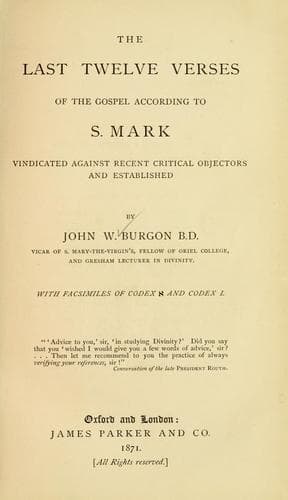
The Last Twelve Verses of the Gospel According to S. MarkBurgon, John William
Religion
The Last Twelve Verses of the Gospel According to S. Mark
Burgon, John William
Bible. Mark XVI, 9-20 -- Criticism, Textual
(XXIII.) Another complaint:—ἀναληφθῆναι, which is found in ver. 19, occurs
nowhere else in the Gospels.
(1.) True. S. Mark has no fewer than seventy-four verbs which “occur
nowhere else in the Gospels:” and this happens to be one of them? What
possible inconvenience can be supposed to follow from that circumstance?
(2.) But the remark is unreasonable. Ἀναληφθῆναι and ἀνάληψις are words
_proper to the Ascension of our _LORD_ into Heaven_. The two Evangelists
who do _not_ describe that event, are _without_ these words: the two
Evangelists who _do_ describe it, _have_ them.(293) Surely, these are
marks of genuineness, not grounds for suspicion!
It is high time to conclude this discussion.—Much has been said about two
other minute points:—
(XXIV.) It is declared that ἐκεῖνος “is nowhere found absolutely used by
S. Mark:” (the same thing may be said of S. Matthew and of S. Luke also:)
“but always emphatically: whereas in verses 10 and 11, it is absolutely
used.”(294) Another writer says,—“The use of ἐκεῖνος in verses 10, 11, and
13 (twice) in a manner synonymous with ὁ δέ, is peculiar.”(295)
(1.) Slightly peculiar it is, no doubt, but not very, that an Evangelist
who employs an ordinary word in the ordinary way about thirty times in
all, should use it “absolutely” in two consecutive verses.
(2.) But really, until the Critics can agree among themselves as to
_which_ are precisely the offending instances,—(for it is evidently a moot
point whether ἐκεῖνος be emphatic in ver. 13, or not,)—we may be excused
from a prolonged discussion of such a question. I shall recur to the
subject in the consideration of the next Article (XXV.)
(XXV.) So again, it may be freely admitted that “in the 10th and 14th
verses there are sentences without a copulative: whereas Mark always has
the copulative in such cases, particularly καί.” But then,—
(1.) Unless we can be shewn at least two or three other sections of S.
Mark’s Gospel _resembling the present_,—(I mean, passages in which S. Mark
summarizes many disconnected incidents, as he does here,)—is it not plain
that such an objection is wholly without point?
(2.) Two instances are cited. In the latter, (ver. 14), Lachmann and
Tregelles read ὔστερον δέ: and the reading is not impossible. So that the
complaint is really reduced to this,—That in ver. 10 the Evangelist begins
Ἐκεὶνη πορευθεῖσα, instead of saying Καὶ ἐκείνη πορευθεῖσα. And (it is
implied) there is something so abhorrent to probability in this, as
slightly to strengthen the suspicion that the entire context is not the
work of the Evangelist.
Public-domain text, read in full here on John Shaqi.
Reviews
Reviews
No reviews yet
Be the first to share your thoughts on this work.
Elsewhere in the archive
Join the Discussion
Join the discussion
Sign in to leave a comment or review.
Sign InorCreate an account