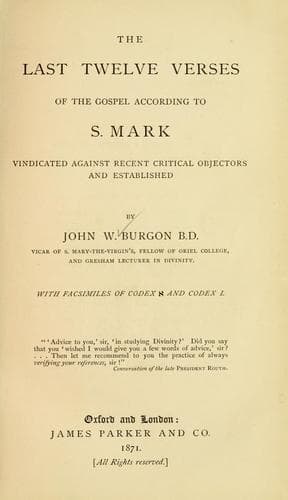
The Last Twelve Verses of the Gospel According to S. MarkBurgon, John William
Religion
The Last Twelve Verses of the Gospel According to S. Mark
Burgon, John William
Bible. Mark XVI, 9-20 -- Criticism, Textual
(3.) Now, suppose we had S. Mark back among us: and suppose that he, on
being shewn this objection, were to be heard delivering himself somewhat
to the following effect:—“Aye. But men may not find fault with _that_ turn
of phrase. I derived it from Simon Peter’s lips. I have always suspected
that it was a kind of echo, so to say, of what he and ‘the other Disciple’
had many a time rehearsed in the hearing of the wondering Church
concerning the Magdalene on the morning of the Resurrection.” And then we
should have remembered the familiar place in the fourth Gospel:—
γύναι τί κλαίεις; τίνα ζητεῖς; ἘΚΕΊΝΗ δοκοῦσα κ.τ.λ.
After which, the sentence would not have seemed at all strange, even
though it be “without a copulative:”—
ἀφ᾽ ἧς ἐκβεβλήκει ἑπτὰ δαιμόνια. ἘΚΕΊΝΗ πορευθεῖσα κ.τ.λ.
(4.) For after all, the _only_ question to be asked is,—Will any one
pretend that such a circumstance as this is _suspicious_? Unless _that_ be
asserted, I see not what is gained by raking together,—(_as one easily
might do in any section of any of the Gospels_,)—every minute peculiarity
of form or expression which can possibly be found within the space of
these twelve verses. It is an evidence of nothing so much as an
incorrigible coarseness of critical fibre, that every slight variety of
manner or language should be thus pounced upon and represented as a note
of spuriousness,—in the face of (_a_) the unfaltering tradition of the
Church universal that the document has _never_ been hitherto suspected:
and (_b_) the known proclivity of all writers, as free moral and
intellectual agents, sometimes to deviate from their else invariable
practice.—May I not here close the discussion?
There will perhaps be some to remark, that however successfully the
foregoing objections may seem to have been severally disposed of, yet that
the combined force of such a multitude of slightly suspicious
circumstances must be not only appreciable, but even remain an
inconvenient, not to say a formidable fact. Let me point out that the
supposed remark is nothing else but a fallacy; which is detected the
instant it is steadily looked at.
For if there really had remained after the discussion of each of the
foregoing XXV Articles, a slight residuum of suspiciousness, _then_ of
course the aggregate of so many fractions would have amounted to something
in the end.
But since it has been proved that there is absolutely _nothing at all_
suspicious in _any_ of the alleged circumstances which have been hitherto
examined, the case becomes altogether different. The sum of ten thousand
nothings is still nothing.(296) This may be conveniently illustrated by an
appeal to the only charge which remains to be examined.
(XXVI. and XXVII.) The absence from these twelve verses of the adverbs
εὐθέως and πάλιν,—(both of them favourite words with the second
Evangelist,)—has been pointed out as one more suspicious circumstance. Let
us take the words singly:—
Public-domain text, read in full here on John Shaqi.
Reviews
Reviews
No reviews yet
Be the first to share your thoughts on this work.
Elsewhere in the archive
Join the Discussion
Join the discussion
Sign in to leave a comment or review.
Sign InorCreate an account