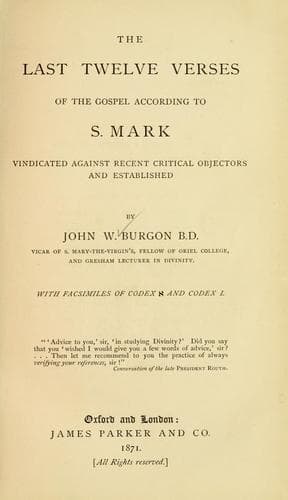
The Last Twelve Verses of the Gospel According to S. MarkBurgon, John William
Religion
The Last Twelve Verses of the Gospel According to S. Mark
Burgon, John William
Bible. Mark XVI, 9-20 -- Criticism, Textual
(_a_) The adverb εὐθέως (or εὐθύς) is indeed of _very_ frequent occurrence
in S. Mark’s Gospel. And yet its absence from chap. xvi is _proved_ to be
in no degree a suspicious circumstance, from the discovery that though it
occurs as many as
12 times in chap. i;
and 6 times in chap. v;
and 5 times in chap. iv, vi;
and 3 times in chap. ii, ix, xiv;
and 2 times in chap. vii, xi;
it yet occurs only 1 times in chap. iii, viii, x, xv;
while it occurs 0 times in chap. xii, xiii, xvi.
(b) In like manner, πάλιν, which occurs as often as
6 times in chap. xiv;
and 5 times in chap. x;
and 3 times in chap. viii, xv;
and 2 times in chap. ii, iii, vii, xi, xii;
and 1 times in chap. iv, v;
occurs 0 times in chap. i, vi, ix, xiii. xvi.(297)
(1.) Now,—How can it possibly be more suspicious that πάλιν should be
absent from _the last twelve_ verses of S. Mark, than that it should be
away from _the first forty-five_?
(2.) Again. Since εὐθέως is not found in the xiith or the xiiith chapters
of this same Gospel,—nor πάλιν in the ist, vith, ixth, or xiiith
chapter,—(for the sufficient reason that _neither word is wanted in any of
those places_,)—what possible “suspiciousness” can be supposed to result
from the absence of both words from the xvith chapter also, where _also_
neither of them is wanted? _Why_ is the xvith chapter of S. Mark’s
Gospel,—or rather, why are “the last twelve verses” of it,—to labour under
such special disfavor and discredit?
(3.) Dr. Tregelles makes answer,—“I am well aware that arguments on
_style_ are often very fallacious, and that _by themselves_ they prove
very little: but when there does exist external evidence, and when
internal proofs as to style, manner, verbal expression, and connection,
are in accordance with such independent grounds of forming a judgment;
then these internal considerations possess very great weight.”(298)—For
all rejoinder, the respected writer is asked,—(_a_) But when there _does
not_ exist any such external evidence: what then? Next, he is reminded
(_b_) That whether there does, or does not, it is at least certain that
_not one_ of those “proofs as to style,” &c., of which he speaks, has been
able to stand the test of strict examination. Not only is the
precariousness of all such Criticism as has been brought to bear against
the genuineness of S. Mark xvi. 9-20 excessive, but the supposed facts
adduced in evidence have been found out to be every one of them
_mistakes_;—being either, (1) demonstrably without argumentative cogency
of any kind;—or else, (2) distinctly corroborative and confirmatory
circumstances: indications that this part of the Gospel is indeed by S.
Mark,—_not_ that it is probably the work of another hand.
And thus the formidable enumeration of twenty-seven grounds of suspicion
vanishes out of sight: fourteen of them proving to be frivolous and
nugatory; and _thirteen_, more or less clearly witnessing _in favour_ of
the section.(299)
Public-domain text, read in full here on John Shaqi.
Reviews
Reviews
No reviews yet
Be the first to share your thoughts on this work.
Elsewhere in the archive
Join the Discussion
Join the discussion
Sign in to leave a comment or review.
Sign InorCreate an account