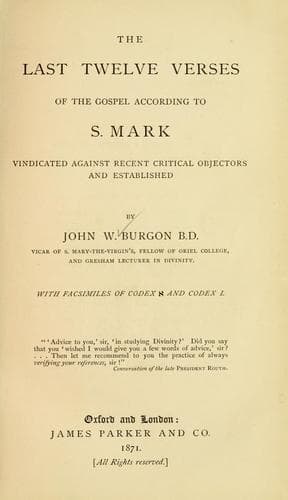
The Last Twelve Verses of the Gospel According to S. MarkBurgon, John William
Religion
The Last Twelve Verses of the Gospel According to S. Mark
Burgon, John William
Bible. Mark XVI, 9-20 -- Criticism, Textual
III. Of these thirteen expressions, some are even eloquent in their
witness. I am saying that it is impossible not to be exceedingly struck by
the discovery that this portion of the Gospel contains (as I have
explained already) so many indications of S. Mark’s undoubted manner. Such
is the reference to ἡ κτίσις (in ver. 15):—the mention of ἀπιστία (in ver.
14):—the occurrence of the verb πορεύεσθαι (in ver. 10 and 12),—of the
phrase ἐν τῷ ὀνόματί μου (in ver. 17),—and of the phrase χεῖρας ἐτιτιθέναι
ἐπί τινα (in ver. 18):—of the Evangelical term for our LORD’S Ascension,
viz. ἀνελήφθη (in ver. 19):—and lastly, of the compounds παρακολουθεῖν and
ἐπακολουθεῖν (in verses 17 and 20.)
To these Thirteen, will have to be added all those other notes of identity
of authorship,—such as they are,—which result from recurring identity of
phrase, and of which the assailants of this portion of the Gospel have
prudently said nothing. Such are the following:—
(xiv.) Ἀνίσταναι, for rising _from the dead_; which is one of S. Mark’s
words. Taking into account the shortness of his Gospel, he has it thrice
as often as S. Luke; _twelve times_ as often as S. Matthew or S. John.
(xv.) The idiomatic expression πορευομένοις εἰς ἀγρόν, of which S. Matthew
does not present a single specimen; but which occurs three times in the
short Gospel of S. Mark,(300)—of which ver. 12 is one.
(xvi.) The expression προί (in ver. 9,)—of which S. Mark avails himself
six times: i.e. (if the length of the present Gospel be taken into
account) almost five times as often as either S. Matthew or S. John,—S.
Luke never using the word at all. In his first chapter (ver. 35), and here
in his last (ver. 2), S. Mark uses λίαν in connexion with προί.
(xvii.) The phrase κηρύσσειν τὸ εὐαγγέλιον (in ver. 15) is another of S.
Mark’s phrases. Like S. Matthew, he employs it four times (i. 14: xiii.
10: xiv. 9: xvi. 15): but it occurs neither in S. Luke’s nor in S. John’s
Gospel.
(xviii.) The same _words_ singly are characteristic of his Gospel. Taking
the length of their several narratives into account, S. Mark has the word
κηρύσσειν more than twice as often as S. Matthew: three times as often as
S. Luke.
(xix.) εὐαγγέλιον,—a word which occurs only in the first two Gospels,—is
found twice as often in S. Mark’s as in S. Matthew’s Gospel: and if the
respective length of their Gospels be considered, the proportion will be
as three to one. It occurs, as above stated, in ver. 15.
(xx.) If such Critics as Dr. Davidson had been concerned to vindicate _the
genuineness_ of this section of the Gospel, we should have been assured
that φανερουσθαι is another of S. Mark’s words: by which they would have
meant no more than this,—that though employed neither by S. Matthew nor by
S. Luke it is used thrice by S. Mark,—being found twice in this section
(verses 12, 14), as well as in ch. iv. 22.
Public-domain text, read in full here on John Shaqi.
Reviews
Reviews
No reviews yet
Be the first to share your thoughts on this work.
Elsewhere in the archive
Join the Discussion
Join the discussion
Sign in to leave a comment or review.
Sign InorCreate an account