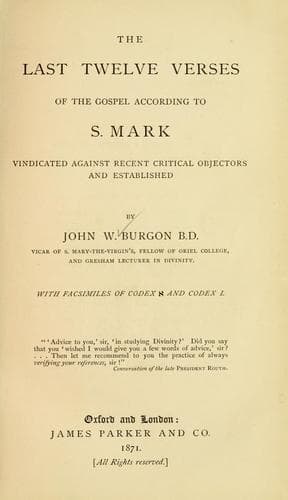
The Last Twelve Verses of the Gospel According to S. MarkBurgon, John William
Religion
The Last Twelve Verses of the Gospel According to S. Mark
Burgon, John William
Bible. Mark XVI, 9-20 -- Criticism, Textual
(xxi.) They would have also pointed out that σκληροκαρδία is another of S.
Mark’s words: being employed neither by S. Luke nor by S. John,—by S.
Matthew only once,—but by S. Mark on _two_ occasions; of which ch. xvi. 14
is one.
(xxii.) In the same spirit, they would have bade us observe that πανταχοῦ
(ver. 20)—unknown to S. Matthew and S. John, and employed only once by S.
Luke,—is _twice_ used by S. Mark; one instance occurring in the present
section.
Nor would it have been altogether unfair if they had added that the
precisely similar word πανταχόθεν (or πάντοθεν) is only found in this same
Gospel,—viz. in ch. i. 45.
(xxiii.) They would further have insisted (and this time with a greater
show of reason) that the adverb καλῶς (which is found in ver. 18) is
another favorite word with S. Mark: occurring as it does, (when the length
of these several narratives is taken into account,) more than twice as
often in S. Mark’s as in S. John’s Gospel,—just three times as often as in
the Gospel of S. Matthew and S. Luke.
(xxiv.) A more interesting (because a more just) observation would have
been that ἔχειν, in the sense of “to be,” (as in the phrase καλῶς ἔχειν,
ver. 18,) is characteristic of S. Mark. He has it oftener than any of the
Evangelists, viz. six times in all (ch. i. 32, 34: ii. 17: v. 23: vi. 55:
xvi. 18.) Taking the shortness of his Gospel into account, he employs this
idiom twice as often as S. Matthew;—three times as often as S. John;—four
times as often as S. Luke.
(xxv.) They would have told us further that ἄῤῥωστος is another of S.
Mark’s favorite words: for that he has it _three_ times,—viz. in ch. vi.
5, 13, and here in ver. 18. S. Matthew has it only once. S. Luke and S.
John not at all.
(xxvi.) And we should have been certainly reminded by them that the
conjunction of πενθοῦσι καὶ κλαίουσι (in ver. 10) is characteristic of S.
Mark,—who has κλαίοντας καὶ ἀλαλάζοντας in ch. v. 38: θορυβεῖσθε και
κλαίετε in the very next verse. As for πενθεῖν, it is one of the 123 words
common to S. Matthew and S. Mark, and peculiar to their two Gospels.
(xxvii.) Lastly, “κατακρίνω (in ver. 16), instead of κρίνω, is Mark’s
word, (comp. x. 33: xiv. 64).” The simple verb which is used four times by
S. Matthew, five times by S. Luke, nineteen times by S. John, is never at
all employed by S. Mark: whereas the compound verb he has oftener in
proportion than S. Matthew,—more than twice as often as either S. Luke or
S. John.
Strange,—that there should be exactly “xxvii” notes of genuineness
discoverable in these twelve verses, instead of “XXVII” grounds of
suspicion!
But enough of all this. Here, we may with advantage review the progress
hitherto made in this inquiry.
Public-domain text, read in full here on John Shaqi.
Reviews
Reviews
No reviews yet
Be the first to share your thoughts on this work.
Elsewhere in the archive
Join the Discussion
Join the discussion
Sign in to leave a comment or review.
Sign InorCreate an account