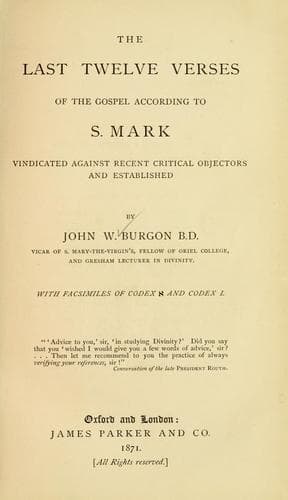
The Last Twelve Verses of the Gospel According to S. MarkBurgon, John William
Religion
The Last Twelve Verses of the Gospel According to S. Mark
Burgon, John William
Bible. Mark XVI, 9-20 -- Criticism, Textual
1. Tischendorf disposes of the whole question in a single sentence. “That
these verses were not written by Mark,” (he says,) “admits of satisfactory
proof.” He then recites in detail the adverse external testimony which his
predecessors had accumulated; remarking, that it is abundantly confirmed
by internal evidence. Of this he supplies a solitary sample; but declares
that the whole passage is “abhorrent” to S. Mark’s manner. “The facts of
the case being such,” (and with this he dismisses the subject,) “a healthy
piety reclaims against the endeavours of those who are for palming off as
Mark’s what the Evangelist is so plainly shewn to have known nothing at
all about.”(14) A mass of laborious annotation which comes surging in at
the close of verse 8, and fills two of Tischendorf’s pages, has the effect
of entirely divorcing the twelve verses in question from the inspired text
of the Evangelist. On the other hand, the evidence _in favour_ of the
place is despatched in less than twelve lines. What can be the reason that
an Editor of the New Testament parades elaborately every particular of the
evidence, (such as it is,) _against_ the genuineness of a considerable
portion of the Gospel; and yet makes summary work with the evidence in its
favour? That Tischendorf has at least entirely made up his mind on the
matter in hand is plain. Elsewhere, he speaks of the Author of these
verses as “_Pseudo Marcus_.”(15)
2. Dr. Tregelles has expressed himself most fully on this subject in his
“Account of the Printed Text of the Greek New Testament” (1854). The
respected author undertakes to shew “that the early testimony that S. Mark
did not write these verses is confirmed by existing monuments.”
Accordingly, he announces as the result of the propositions which he
thinks he has established, “that the _book of Mark himself_ extends no
further than ἐφοβοῦντο γάρ.” He is the only critic I have met with to whom
it does not seem incredible that S. Mark did actually conclude his Gospel
in this abrupt way: observing that “perhaps we do not know enough of the
circumstances of S. Mark when he wrote his Gospel to say whether he did or
did not leave it with a complete termination.” In this modest suggestion
at least Dr. Tregelles is unassailable, since we know absolutely nothing
whatever about “the circumstances of S. Mark,” (or of any other
Evangelist,) “when he wrote his Gospel:” neither indeed are we quite sure
_who_ S. Mark _was_. But when he goes on to declare, notwithstanding,
“that the remaining twelve verses, by whomsoever written, have a full
claim to be received as an authentic part of the second Gospel;” and
complains that “there is in some minds a kind of timidity with regard to
Holy Scripture, as if all our notions of its authority depended on our
knowing who was the writer of each particular portion; instead of simply
seeing and owning that it was given forth from GOD, and that it is as much
Public-domain text, read in full here on John Shaqi.
Reviews
Reviews
No reviews yet
Be the first to share your thoughts on this work.
Join the Discussion
Join the discussion
Sign in to leave a comment or review.
Sign InorCreate an account