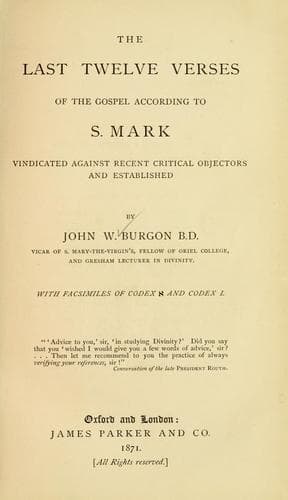
The Last Twelve Verses of the Gospel According to S. MarkBurgon, John William
Religion
The Last Twelve Verses of the Gospel According to S. Mark
Burgon, John William
Bible. Mark XVI, 9-20 -- Criticism, Textual
His as were the Commandments of the Law written by His own finger on the
tables of stone;”(16)—the learned writer betrays a misapprehension of the
question at issue, which we are least of all prepared to encounter in such
a quarter. We admire his piety but it is at the expense of his critical
sagacity. For the question is not at all one of _authorship_, but only one
of _genuineness_. Have the codices been _mutilated_ which do _not_ contain
these verses? If they have, then must these verses be held to be
_genuine_. But on the contrary, Have the codices been _supplemented_ which
contain them? Then are these verses certainly _spurious_. There is no help
for it but they must either be held to be an integral part of the Gospel,
and therefore, in default of any proof to the contrary, as certainly by S.
Mark as any other twelve verses which can be named; or else an
unauthorized addition to it. If they belong to the post-apostolic age it
is idle to insist on their Inspiration, and to claim that this “authentic
anonymous addition to what Mark himself wrote down” is as much the work of
GOD “as were the Ten Commandments written by His own finger on the tables
of stone.” On the other hand, if they “ought as much to be received as
part of our second Gospel as the last chapter of Deuteronomy (unknown as
the writer is) is received as the right and proper conclusion of the book
of Moses,”—it is difficult to understand why the learned editor should
think himself at liberty to sever them from their context, and introduce
the subscription ΚΑΤΑ ΜΑΡΚΟΝ after ver. 8. In short, “How persons who
believe that these verses did not form a part of the original Gospel of
Mark, but were added afterwards, can say that they have a good claim to be
received as an authentic or genuine part of the second Gospel, that is, a
portion of canonical Scripture, passes comprehension.” It passes even Dr.
Davidson’s comprehension; (for the foregoing words are his;) and Dr.
Davidson, as some of us are aware, is not a man to stick at trifles.(17)
Public-domain text, read in full here on John Shaqi.
Reviews
Reviews
No reviews yet
Be the first to share your thoughts on this work.
Join the Discussion
Join the discussion
Sign in to leave a comment or review.
Sign InorCreate an account