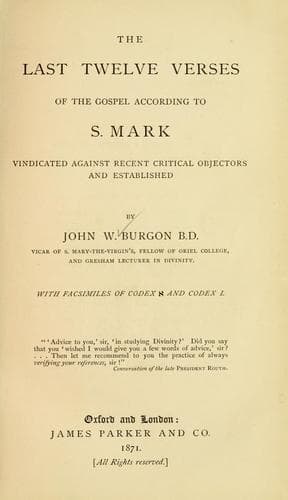
The Last Twelve Verses of the Gospel According to S. MarkBurgon, John William
Religion
The Last Twelve Verses of the Gospel According to S. Mark
Burgon, John William
Bible. Mark XVI, 9-20 -- Criticism, Textual
1. I cannot see for whom I should be writing; in other words,—what I
should propose to myself as the end to be attained by what I wrote. For,
2. What would be gained by demonstrating,—(as I am of course prepared to
do,)—that there is really _no inconsistency whatever_ between anything
which S. Mark here says, and what the other Evangelists deliver? I should
have proved that,—(assuming the _other_ Evangelical narratives to be
authentic, i.e. historically true,)—the narrative before us cannot be
objected to on the score of its not being authentic also. But _by whom_ is
such proof required?
(_a_) Not by the men who insist that errors are occasionally to be met
with in the Evangelical narratives. In _their_ estimation, _the
genuineness of an inspired writing_ is a thing not in the least degree
rendered suspicious by the erroneousness of its statements. According to
them, the narrative may exhibit inaccuracies and inconsistencies, and may
yet be the work of S. Mark. If the inconsistencies be but “trifling,” and
the inaccuracies “minute,”—these “sound Theologians,” (for so they style
themselves,(325)) “have no dread whatever of acknowledging” their
existence. Be it so. Then would it be a gratuitous task to set about
convincing _them_ that no inconsistency, no inaccuracy is discoverable
within the compass of these Twelve concluding Verses.
(_b_) But neither is such proof required by faithful Readers; who, for
want of the requisite Scientific knowledge, are unable to discern the
perfect Harmony of the Evangelical narratives in this place. It is only
one of many places where a primâ facie discrepancy, though it does not
fail to strike,—yet (happily) altogether fails to distress them.
Consciously or unconsciously, such readers reason with themselves somewhat
as follows:—"GOD’S Word, like all GOD’S other Works, (and I am taught to
regard GOD’S Word as a very masterpiece of creative skill;)—the blessed
Gospel, I say, is _full_ of difficulties. And yet those difficulties are
observed invariably to disappear under competent investigation. Can I
seriously doubt that if sufficient critical skill were brought to bear on
the highly elliptical portion of narrative contained in these Twelve
Verses, it would present no exception to a rule which is observed to be
else universal; and that any apparent inconsistency between S. Mark’s
statements in this place, and those of S. Luke and S. John, would also be
found to be imaginary only?"
This then is the reason why I abstain from entering upon a prolonged
Inquiry, which would in fact necessitate a discussion of _the Principles
of Gospel Harmony_,—for which the present would clearly not be the proper
place.
VIII. Let it suffice that, in the foregoing pages,—
1. I have shewn that the supposed argument from “Style,” (in itself a
highly fallacious test,) disappears under investigation.
Public-domain text, read in full here on John Shaqi.
Reviews
Reviews
No reviews yet
Be the first to share your thoughts on this work.
Elsewhere in the archive
Join the Discussion
Join the discussion
Sign in to leave a comment or review.
Sign InorCreate an account