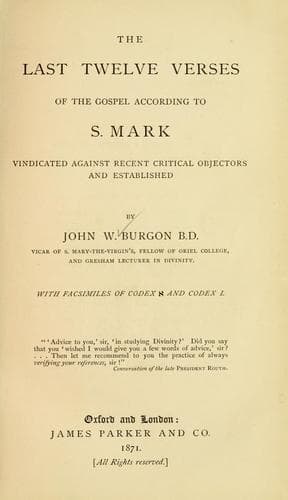
The Last Twelve Verses of the Gospel According to S. MarkBurgon, John William
Religion
The Last Twelve Verses of the Gospel According to S. Mark
Burgon, John William
Bible. Mark XVI, 9-20 -- Criticism, Textual
It has been proved (pp. 142-5) that, on the contrary, the style of S. Mark
xvi. 9-20 is exceedingly like the style of S. Mark i. 9-20; and therefore,
that _it is rendered probable by the Style_ that the Author of the
beginning of this Gospel was also the Author of the end of it.
2. I have further shewn that the supposed argument from “Phraseology,”—(in
itself, a most unsatisfactory test; and as it has been applied to the
matter in hand, a very coarse and clumsy one;)—breaks down hopelessly
under severe analysis.
Instead of there being twenty-seven suspicious circumstances in the
Phraseology of these Twelve Verses, it has been proved (pp. 170-3) that in
twenty-seven particulars there emerge _corroborative considerations_.
3. Lastly, I have shewn that a loftier method of Criticism is at hand; and
that, tested by this truer, more judicious, and more philosophical
standard; _a presumption_ of the highest order is created _that these
Verses must needs be the work of S. Mark_.
CHAPTER X.
THE TESTIMONY OF THE LECTIONARIES SHEWN TO BE ABSOLUTELY DECISIVE AS TO
THE GENUINENESS OF THESE VERSES.
The Lectionary of the East shewn to be a work of extraordinary
antiquity (p. 195).—Proved to be older than any extant MS. of the
Gospels, by an appeal to the Fathers (p. 198).—In this Lectionary,
(and also in the Lectionary of the West,) the last Twelve Verses
of S. Mark’s Gospel have, from the first, occupied a most
conspicuous, as well as most honourable place, (p. 204.)—Now, this
becomes the testimony of ante-Nicene Christendom in their favour
(p. 209.)
I have reserved for the last the testimony of THE LECTIONARIES, which has
been hitherto all but entirely overlooked;(326)—passed by without so much
as a word of comment, by those who have preceded me in this inquiry. Yet
is it, when rightly understood, altogether decisive of the question at
issue. And why? Because it is not the testimony rendered by a solitary
father or by a solitary MS.; no, nor even the testimony yielded by a
single Church, or by a single family of MSS. But it is _the united
testimony of all the Churches_. It is therefore the evidence borne by a
“goodly fellowship of Prophets,” a “noble array of Martyrs” indeed; as
well as by _MSS. innumerable which have long since perished_, but which
must of necessity once have been. And so, it comes to us like the voice of
many waters: dates, (as I shall shew by-and-by,) from a period of
altogether immemorial antiquity: is endorsed by the sanction of all the
succeeding ages: admits of neither doubt nor evasion. This subject, in
order that it may be intelligibly handled, will be most conveniently
approached by some remarks which shall rehearse the matter from the
beginning.
Public-domain text, read in full here on John Shaqi.
Reviews
Reviews
No reviews yet
Be the first to share your thoughts on this work.
Elsewhere in the archive
Join the Discussion
Join the discussion
Sign in to leave a comment or review.
Sign InorCreate an account