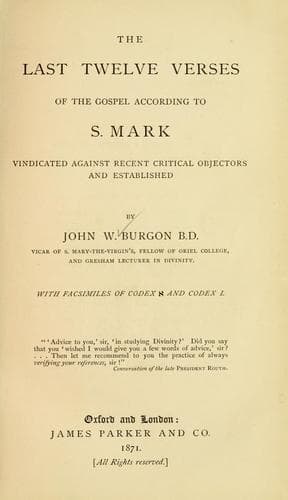
The Last Twelve Verses of the Gospel According to S. MarkBurgon, John William
Religion
The Last Twelve Verses of the Gospel According to S. Mark
Burgon, John William
Bible. Mark XVI, 9-20 -- Criticism, Textual
The Christian Church succeeded to the Jewish. The younger society
inherited the traditions of the elder, not less as a measure of necessity
than as a matter of right; and by a kind of sacred instinct conformed
itself from the very beginning in countless particulars to its
divinely-appointed model. The same general Order of Service went on
unbroken,—conducted by a Priesthood whose spiritual succession was at
least as jealously guarded as had been the natural descent from Aaron in
the Church of the Circumcision.(327) It was found that “the Sacraments of
the Jews are [but] types of ours.”(328) Still were David’s Psalms
antiphonally recited, and the voices of “Moses and the Prophets” were
heard in the sacred assemblies of God’s people “every Sabbath day.”
Canticle succeeded to Canticle; while many a Versicle simply held its
ground. The congenial utterances of the chosen race passed readily into
the service of the family of the redeemed. Unconsciously perhaps, the very
method of the one became adopted by the other: as, for example, the method
of beginning a festival from the “Eve” of the preceding Day. The
Synagogue-worship became transfigured; but it did not part with one of its
characteristic features. Above all, the same three great Festivals were
still retained which declare “the rock whence we are hewn and the hole of
the pit whence we are digged:” only was it made a question, a controversy
rather, whether Easter should or should not be celebrated _with the
Jews_.(329)
But it is the faithful handing on to the Christian community of _the
Lectionary practice_ of the Synagogue to which the reader’s attention is
now exclusively invited. That the Christian Church inherited from the
Jewish the practice of reading a first and a second Lesson in its public
assemblies, is demonstrable. What the Synagogue practice was in the time
of the Apostles is known from Acts xiii. 15, 27. Justin Martyr, (A.D. 150)
describes the Christian practice in his time as precisely similar:(330)
only that for “the Law,” there is found to have been at once substituted
“the Gospel.” He speaks of the writings of “_the Apostles_” and of “the
Prophets.” Chrysostom has the same expression (for the two Lessons) in one
of his Homilies.(331) Cassian (A.D. 400) says that in Egypt, after the
Twelve Prayers at Vespers and at Matins, two Lessons were read, one out of
the Old Testament and the other out of the New. But _on Saturdays_ and
_Sundays_, and the fifty days of Pentecost, both Lessons were from the New
Testament,—one from the Epistles or the Acts of the Apostles; the other,
from the Gospels.(332) Our own actual practice seems to bear a striking
resemblance to that of the Christian Church at the earliest period: for we
hear of (1) “Moses and the Prophets,” (which will have been the carrying
on of the old synagogue-method, represented by our first and second
Lesson,)—(2) a lesson out of the “Epistles or Acts,” together with a
Public-domain text, read in full here on John Shaqi.
Reviews
Reviews
No reviews yet
Be the first to share your thoughts on this work.
Elsewhere in the archive
Join the Discussion
Join the discussion
Sign in to leave a comment or review.
Sign InorCreate an account