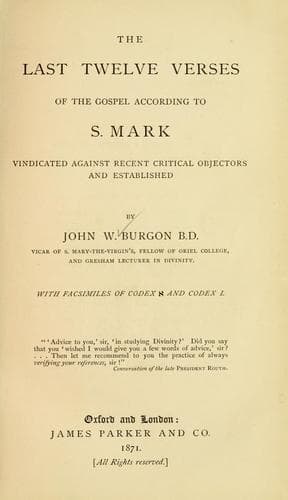
The Last Twelve Verses of the Gospel According to S. MarkBurgon, John William
Religion
The Last Twelve Verses of the Gospel According to S. Mark
Burgon, John William
Bible. Mark XVI, 9-20 -- Criticism, Textual
lesson out of the “Gospels.”(333) It is, in fact, universally received
that the Eastern Church has, from a period of even Apostolic antiquity,
enjoyed a Lectionary,—or established system of Scripture lessons,—of her
own. In its conception, this Lectionary is discovered to have been
fashioned (as was natural) upon the model of the Lectionary of God’s
ancient people, the Jews: for it commences, as theirs did, _in the
autumn_, (in September(334)); and prescribes two immovable “Lections” for
every _Saturday_ (as well as for every Sunday) in the year: differing
chiefly in this,—that the prominent place which had been hitherto assigned
to “the Law and the Prophets,”(335) was henceforth enjoyed by the Gospels
and the Apostolic writings. “Saturday-Sunday” lections—(σαββατοκυριακαί,
for so these Lections were called,)—retain their place in the “Synaxarium”
of the East to the present hour. It seems also a singular note of
antiquity that the Sabbath and the Sunday succeeding it do as it were
cohere, and bear one appellation; so that the week takes its name—_not_
from the Sunday with which it commences,(336) but—from the
Sabbath-and-Sunday with which _it concludes_. To mention only one out of a
hundred minute traits of identity which the public Service of the
sanctuary retained:—Easter Eve, which from the earliest period to this day
has been called “μέγα σάββατον,”(337) is discovered to have borne the
self-same appellation in the Church of the Circumcision.(338)—If I do not
enter more minutely into the structure of the Oriental Lectionary,—(some
will perhaps think I have said too much, but the interest of the subject
ought to be a sufficient apology,)—it is because further details would be
irrelevant to my present purpose; which is only to call attention to the
three following facts:
(I.) That the practice in the Christian Church of reading publicly before
the congregation certain fixed portions of Holy Writ, according to an
established and generally received rule, must have existed from a period
long anterior to the date of any known Greek copy of the New Testament
Scriptures.
(II.) That although there happens to be extant neither “Synaxarium,” (i.e.
Table of Proper Lessons of the Greek Church), nor “Evangelistarium,” (i.e.
Book containing the Ecclesiastical Lections _in extenso_), of higher
antiquity than the viiith century,—yet that the scheme itself, as
exhibited by those monuments,—certainly in every essential particular,—is
older than any known Greek MS. which contains it, by _at least_ four, in
fact by full _five_ hundred years.
(III.) Lastly,—That in the said Lectionaries of the Greek and of the
Syrian Churches, the twelve concluding verses of S. Mark which are the
subject of discussion throughout the present pages are observed
_invariably_ to occupy the same singularly conspicuous, as well as most
honourable place.
Public-domain text, read in full here on John Shaqi.
Reviews
Reviews
No reviews yet
Be the first to share your thoughts on this work.
Elsewhere in the archive
Join the Discussion
Join the discussion
Sign in to leave a comment or review.
Sign InorCreate an account