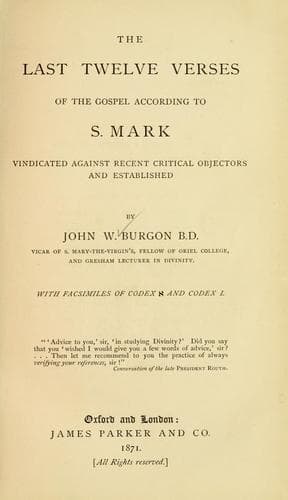
The Last Twelve Verses of the Gospel According to S. MarkBurgon, John William
Religion
The Last Twelve Verses of the Gospel According to S. Mark
Burgon, John William
Bible. Mark XVI, 9-20 -- Criticism, Textual
I. The first of the foregoing propositions is an established fact. It is
at least quite certain that in the ivth century (if not long before) there
existed a known Lectionary system, alike in the Church of the East and of
the West. Cyril of Jerusalem (A.D. 348,) having to speak about our LORD’s
Ascension, remarks that by a providential coincidence, on the previous
day, which was Sunday, the event had formed the subject of the appointed
lessons;(339) and that he had availed himself of the occasion to discourse
largely on the subject.—Chrysostom, preaching at Antioch, makes it plain
that, in the latter part of the ivth century, the order of the lessons
which were publicly read in the Church _on Saturdays and Sundays_(340) was
familiarly known to the congregation: for he invites them to sit down, and
study attentively beforehand, at home, the Sections (περικοπάς) of the
Gospel which they were about to hear in Church.(341)—Augustine is express
in recording that in his time proper lessons were appointed for Festival
days;(342) and that an innovation which he had attempted on Good Friday
had given general offence.(343)—Now by these few notices, to look no
further, it is rendered certain that a Lectionary system of _some_ sort
must have been in existence at a period long anterior to the date of any
copy of the New Testament Scriptures extant. I shall shew by-and-by that
the fact is established by the Codices (B, א, A, C, D) themselves.
But we may go back further yet; for not only Eusebius, but Origen and
Clemens Alexandrinus, by their habitual use of the technical term for an
Ecclesiastical Lection (περικοπή, ἀνάγνωσις, ἀνάγνωσμα,) remind us that
the Lectionary practice of the East was already established in their
days.(344)
II. The Oriental Lectionary consists of “Synaxarion” and “Eclogadion,” (or
Tables of Proper Lessons from the Gospels and Apostolic writings daily
throughout the year;) together with “Menologion,” (or Calendar of
immovable Festivals and Saints’ Days.) That we are thoroughly acquainted
with all of these, as exhibited in Codices of the viiith, ixth and xth
centuries,—is a familiar fact; in illustration of which it is enough to
refer the reader to the works cited at the foot of the page.(345) But it
is no less certain that the scheme of Proper Lessons itself is of much
higher antiquity.
Public-domain text, read in full here on John Shaqi.
Reviews
Reviews
No reviews yet
Be the first to share your thoughts on this work.
Elsewhere in the archive
Join the Discussion
Join the discussion
Sign in to leave a comment or review.
Sign InorCreate an account