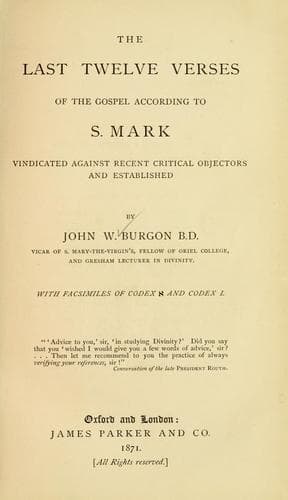
The Last Twelve Verses of the Gospel According to S. MarkBurgon, John William
Religion
The Last Twelve Verses of the Gospel According to S. Mark
Burgon, John William
Bible. Mark XVI, 9-20 -- Criticism, Textual
1. The proof of this, if it could only be established by an induction of
particular instances, would not only be very tedious, but also very
difficult indeed. It will be perceived, on reflection, that even when the
occasion of a Homily (suppose) is actually recorded, the Scripture
references which it contains, apart from the Author’s statement that what
he quotes _had_ formed part of that day’s Service, creates scarcely so
much as a presumption of the fact: while the correspondence, however
striking, between such references to Scripture and the Lectionary as we
have it, is of course no proof whatever that we are so far in possession
of the Lectionary of the Patristic age. Nay, on famous Festivals, the
employment of certain passages of Scripture is, in a manner,
inevitable,(346) and may on no account be pressed.
2. Thus, when Chrysostom(347) and when Epiphanius,(348) preaching on
Ascension Day, refer to Acts i. 10, 11,—we do not feel ourselves warranted
to press the coincidence of such a quotation with the Liturgical section
of the day.—So, again, when Chrysostom preaches on Christmas Day, and
quotes from S. Matthew ii. 1, 2;(349) or on Whitsunday, and quotes from S.
John vii. 38 and Acts ii. 3 and 13;—though both places form part of the
Liturgical sections for the day, no _proof_ results therefrom that either
chapter was actually used.
3. But we are not reduced to this method. It is discovered that nearly
three-fourths of Chrysostom’s Homilies on S. Matthew either begin at the
first verse of _a known Ecclesiastical Lection_; or else at the first
ensuing verse after the close of one. Thirteen of those Homilies in
succession (the 63rd to the 75th inclusive) begin with _the first words of
as many known Lections_. “Let us attend to this delightful section
(περικοπή) which we never cease turning to,”—are the opening words of
Chrysostom’s 79th Homily, of which “the text” is S. Matth. xxv. 31, i.e.
the beginning of the Gospel for Sexagesima Sunday.—Cyril of Alexandria’s
(so called) “Commentary on S. Luke” is nothing else but a series of short
Sermons, for the most part delivered on _known Ecclesiastical Lections_;
which does not seem to have been as yet observed.—Augustine (A.D. 416)
says expressly that he had handled S. John’s Gospel in precisely the same
way.(350)—All this is significant in a high degree.
4. I proceed, however, to adduce a few distinct proofs that the existing
Lectionary of the great Eastern Church,—as it is exhibited by Matthaei, by
Scholz, and by Scrivener from MSS. of the viiith century,—and which is
contained in Syriac MSS. of the vith and viith—must needs be in the main a
work of extraordinary antiquity. And if I do not begin by insisting that
at least one century more may be claimed for it by a mere appeal to the
Hierosolymitan Version, it is only because I will never knowingly admit
what may prove to be untrustworthy materials(351) into my foundations.
Public-domain text, read in full here on John Shaqi.
Reviews
Reviews
No reviews yet
Be the first to share your thoughts on this work.
Elsewhere in the archive
Join the Discussion
Join the discussion
Sign in to leave a comment or review.
Sign InorCreate an account