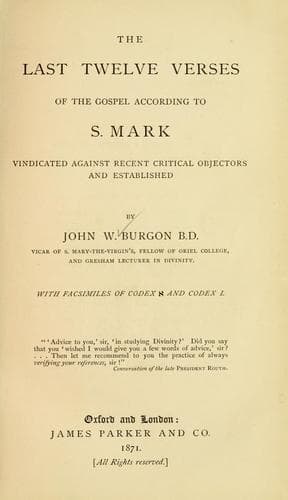
The Last Twelve Verses of the Gospel According to S. MarkBurgon, John William
Religion
The Last Twelve Verses of the Gospel According to S. Mark
Burgon, John William
Bible. Mark XVI, 9-20 -- Criticism, Textual
(_a_) “Every one is aware,” (says Chrysostom in a sermon on our SAVIOUR’S
Baptism, preached at Antioch, A.D. 387,) “that this is called the Festival
of the Epiphany. Two manifestations are thereby intended: concerning both
of which _you have heard this day S. Paul discourse in his Epistle to
Titus_.”(352) Then follows a quotation from ch. ii. 11 to 13,—which proves
to be the beginning of the lection for the day in the Greek Menology. In
the time of Chrysostom, therefore, Titus ii. 11, 12, 13 formed part of one
of the Epiphany lessons,—as it does to this hour in the Eastern Church.
What is scarcely less interesting, it is also found to have been part of
the Epistle for the Epiphany in the old Gallican Liturgy,(353) the
affinities of which with the East are well known.
(_b_) Epiphanius (speaking of the Feasts of the Church) says, that at the
Nativity, a Star shewed that the WORD had become incarnate: at the
“Theophania” (_our_ “Epiphany”) John cried, “Behold the Lamb of GOD,” &c.,
and a Voice from Heaven proclaimed Him at His Baptism. Accordingly, S.
Matth. ii. 1-12 is found to be the ancient lection for Christmas Day: S.
Mark i. 9-11 and S. Matth. iii. 13-17 the lections for Epiphany. On the
morrow, was read S. John i. 29-34.
(_c_) In another of his Homilies, Chrysostom explains with considerable
emphasis the reason why the Book of the Acts was read publicly in Church
during the interval between Easter and Pentecost; remarking, that it had
been the liturgical arrangement of a yet earlier age.(354)—After such an
announcement, it becomes a very striking circumstance that Augustine also
(A.D. 412) should be found to bear witness to the prevalence of the same
liturgical arrangement in the African Church.(355) In the old Gallican
Lectionary, as might have been expected, the same rule is recognisable. It
ought to be needless to add that the same arrangement is observed
universally to prevail in the Lectionaries both of the East and of the
West to the present hour; although the fact must have been lost sight of
by the individuals who recently, under pretence of “_making some
advantageous alterations_” in our Lectionary, have constructed an entirely
new one,—vicious in principle and liable to the gravest objections
throughout,—whereby _this_ link also which bound the Church of England to
the practice of Primitive Christendom, has been unhappily broken; _this_
note of Catholicity also has been effaced.(356)
(_d_) The purely arbitrary arrangement, (as Mr. Scrivener phrases it), by
which the Book of Genesis, instead of the Gospel, is appointed to be
read(357) on the _week_ days of Lent, is discovered to have been fully
recognised in the time of Chrysostom. Accordingly, the two series of
Homilies on the Book of Genesis which that Father preached, he preached in
Lent.(358)
Public-domain text, read in full here on John Shaqi.
Reviews
Reviews
No reviews yet
Be the first to share your thoughts on this work.
Elsewhere in the archive
Join the Discussion
Join the discussion
Sign in to leave a comment or review.
Sign InorCreate an account