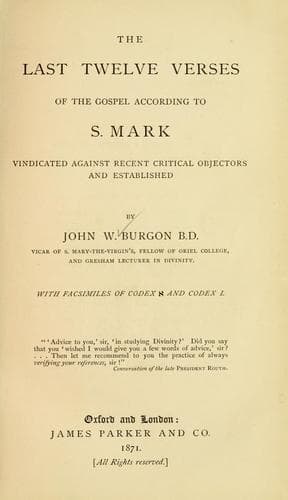
The Last Twelve Verses of the Gospel According to S. MarkBurgon, John William
Religion
The Last Twelve Verses of the Gospel According to S. Mark
Burgon, John William
Bible. Mark XVI, 9-20 -- Criticism, Textual
(_e_) It will be seen in the next chapter that it was from a very remote
period the practice of the Eastern Church to introduce into the lesson for
Thursday in Holy-week, S. Luke’s account (ch. xxii. 43, 44) of our LORD’S
“Agony and bloody Sweat,” _immediately after S. Matth._ xxvi. 39. _That_
is, no doubt, the reason why Chrysostom,—who has been suspected, (I think
unreasonably,) of employing an Evangelistarium instead of a copy of the
Gospels in the preparation of his Homilies, is observed to quote those
same two verses in that very place in his Homily on S. Matthew;(359) which
shews that the Lectionary system of the Eastern Church in this respect is
at least as old as the ivth century.
(_f_) The same two verses used to be _left out_ on the Tuesday after
Sexagesima (τῇ γ᾽ τῆς τυροφάγου) for which day S. Luke xxii. 39-xxiii. 1,
is the appointed lection. And _this_ explains why Cyril (A.D. 425) in his
Homilies on S. Luke, passes them by in silence.(360)
But we can carry back the witness to the Lectionary practice of omitting
these verses, at least a hundred years; for Cod. B, (evidently for that
same reason,) _also_ omits them, as was stated above, in p. 79. They are
wanting also in the Thebaic version, which is of the iiird century.
(_g_) It will be found suggested in the next chapter (page 218) that the
piercing of our LORD’S side, (S. John xix. 34),—thrust into Codd. B and א
immediately after S. Matth. xxvii. 49,—is probably indebted for its place
in those two MSS. to the Eastern Lectionary practice. If this suggestion
be well founded, a fresh proof is obtained that the Lectionary of the East
was fully established in the beginning of the ivth century. But see
Appendix (H).
(_h_) It is a remarkable note of the antiquity of that Oriental Lectionary
system with which we are acquainted, that S. Matthew’s account of the
Passion (ch. xxvii. 1-61,) should be there appointed to be read _alone_ on
the evening of Good Friday. Chrysostom clearly alludes to this
practice;(361) which Augustine expressly states was also the practice in
his own day.(362) Traces of the same method are discoverable in the old
Gallican Lectionary.(363)
(_i_) Epiphanius, (or the namesake of his who was the author of a
well-known Homily on Palm Sunday,) remarks that “yesterday” had been read
the history of the rising of Lazarus.(364) Now S. John xi. 1-45 is the
lection for the antecedent Sabbath, in all the Lectionaries.
Public-domain text, read in full here on John Shaqi.
Reviews
Reviews
No reviews yet
Be the first to share your thoughts on this work.
Elsewhere in the archive
Join the Discussion
Join the discussion
Sign in to leave a comment or review.
Sign InorCreate an account