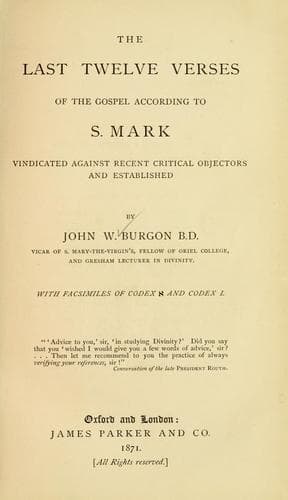
The Last Twelve Verses of the Gospel According to S. MarkBurgon, John William
Religion
The Last Twelve Verses of the Gospel According to S. Mark
Burgon, John William
Bible. Mark XVI, 9-20 -- Criticism, Textual
(_k_) In conclusion, I may be allowed so far to anticipate what will be
found fully established in the next chapter, as to point out here that
since in countless places the text of our oldest Evangelia as well as the
readings of the primitive Fathers exhibit unmistakable traces of the
corrupting influence of the Lectionary practice, _that_ very fact becomes
irrefragable evidence of the antiquity of the Lectionary which is the
occasion of it. Not only must it be more ancient than Cod. B or Cod. א,
(which are referred to the beginning of the ivth century), but it must be
older than Origen in the iiird century, or the Vetus Itala and the Syriac
in the iind. And thus it is demonstrated, (1st) That fixed Lessons were
read in the Churches of the East in the immediately post-Apostolic age;
and (2ndly) That, wherever we are able to test it, the Lectionary of that
remote period corresponded with the Lectionary which has come down to us
in documents of the vith and viith century, and was in fact constructed in
precisely the same way.
I am content in fact to dismiss the preceding instances with this general
remark:—that a System which is found to have been fully recognised
throughout the East and throughout the West in the beginning of the fourth
century, _must of necessity have been established very long before_. It is
as when we read of three British Bishops attending the Council at Arles,
A.D. 314. The Church (we say) which could send out those three Bishops
must have been _fully organized_ at a greatly antecedent period.
4. Let us attend, however, to the great Festivals of the Church. These are
declared by Chrysostom (in a Homily delivered at Antioch 20 Dec. A.D. 386)
to be the five following:—(1) Nativity: (2) the Theophania: (3) Pascha:
(4) Ascension: (5) Pentecost.(365) Epiphanius, his contemporary, (Bishop
of Constantia in the island of Cyprus,) makes the same enumeration,(366)
in a Homily on the Ascension.(367) In the Apostolical Constitutions, the
same five Festivals are enumerated.(368) Let me state a few Liturgical
facts in connexion with each of these.
Public-domain text, read in full here on John Shaqi.
Reviews
Reviews
No reviews yet
Be the first to share your thoughts on this work.
Elsewhere in the archive
Join the Discussion
Join the discussion
Sign in to leave a comment or review.
Sign InorCreate an account